

Table of Contents
- Introduction
- What is Construction HOTO?
- Why Construction Handover Matters
- Construction Industry Challenges
- The Cost of Poor Handover
- Traditional vs Digital HOTO
- Construction HOTO Lifecycle
- Key Stakeholders
- Expert Tip
- What is Construction HOTO? The Complete Workflow, Documentation & Best Practices
- Discipline-Wise Construction HOTO Checklists (Civil, Architectural & Electrical)
- MEP Handover, Testing & Commissioning, Asset Register, O&M Manuals & Warranty Management
- Snag Management, Final Handover, BuildHab Toolkit, FAQs & Conclusion
Introduction
Unfortunately, this happens far more often than many construction professionals realize.
While completing the physical construction of a building is a major achievement, project success isn’t truly measured until the client accepts the building with complete confidence. That confidence depends not only on the quality of the construction itself but also on the quality of the handover process.
A beautifully finished building can still face delayed occupancy if:
- Essential test reports are missing.
- Equipment warranties cannot be located.
- Operation and Maintenance (O&M) manuals are incomplete.
- Snag items remain unresolved.
- Asset information is disorganized.
- Testing and commissioning records are unavailable.
These seemingly small documentation gaps can delay approvals, create disputes, increase operational costs, and reduce client satisfaction.
This is why professional contractors and consultants treat the Handing Over and Taking Over (HOTO) process as one of the most critical stages of the entire project lifecycle.
A structured HOTO process ensures that every inspection, document, certificate, and approval is completed before the building transitions from construction to operation.
In this guide, you’ll learn the complete Construction HOTO process, understand the documents required for a successful handover, and explore practical methods to simplify project closeout using organized tracking systems like the BuildHab Construction HOTO Master Toolkit.
Why Construction Handover Matters
Most people think the construction project ends when the last coat of paint dries.
In reality, construction is only complete when the client confidently accepts ownership of the project.
Project handover is much more than exchanging keys.
It is the formal transfer of:
- Technical knowledge
- Building assets
- Equipment documentation
- Maintenance information
- Warranty records
- Operational responsibility
- Legal accountability
Without proper documentation, even a perfectly constructed building becomes difficult to operate and maintain.
Think of HOTO as the bridge between construction and facility management.
Construction Without HOTO Is Like Buying a Car Without Documents
Imagine purchasing a brand-new luxury car.
The dealer gives you the keys.
But they forget to provide:
- Service book
- Warranty card
- Insurance papers
- User manual
- Spare key
- Registration certificate
Would you consider the purchase complete?
Probably not.
The same principle applies to construction projects.
A building is not truly “complete” until all documentation, inspections, manuals, warranties, and approvals are handed over in an organized manner.
Construction Industry Challenges
Every construction professional has experienced at least one of these situations:
✔ Missing O&M Manuals
✔ Missing Warranty Certificates
✔ Consultants requesting documents multiple times
✔ Different versions of spreadsheets
✔ Lost inspection reports
✔ Delayed occupancy approvals
✔ Incomplete snag lists
✔ Poor coordination between departments
✔ Missing testing records
✔ Asset information scattered across emails
These problems rarely arise because the work wasn’t done—they occur because the information wasn’t managed effectively.
Common Problems During Handover
| Challenge | Impact on the Project |
|---|---|
| Missing Documentation | Delays client approval |
| Unresolved Snag Items | Additional site visits and rework |
| Poor Document Control | Confusion over latest revisions |
| Missing Warranty Information | Future maintenance challenges |
| No Asset Register | Difficult facility management |
| Incomplete Testing Records | Delayed occupancy certificates |
| Poor Communication | Contractor–client disputes |
The Hidden Cost of Poor Handover
Poor handover doesn’t just create paperwork—it affects the entire project.
It can lead to:
- Delayed final payments.
- Extended project closeout periods.
- Increased administrative effort.
- Higher maintenance costs.
- Reduced client trust.
- Operational disruptions after occupancy.
- Difficulty tracking equipment warranties.
- Inefficient facility management.
A structured HOTO process minimizes these risks by ensuring that every required document, inspection, and approval is captured before handover.
Traditional Handover vs Digital HOTO
| Traditional Method | Digital HOTO Approach |
|---|---|
| Multiple Excel files | Centralized workbook |
| Paper checklists | Digital tracking |
| Email attachments | Organized document control |
| Manual status updates | Live progress dashboard |
| Lost warranties | Warranty tracker |
| Scattered O&M manuals | O&M tracker |
| Separate snag sheets | Integrated snag tracker |
| Manual reporting | Automated summaries |
Digital HOTO doesn’t replace engineering expertise—it enhances it by improving visibility, consistency, and collaboration.
Construction HOTO Lifecycle
Project Planning
        │
        ▼
Construction Execution
        │
        ▼
Quality Inspections
        │
        ▼
Testing & Commissioning
        │
        ▼
Snag Identification
        │
        ▼
Snag Rectification
        │
        ▼
Documentation Compilation
        │
        ▼
Client Inspection
        │
        ▼
Final Approval
        │
        ▼
Handing Over
        │
        ▼
Facility Management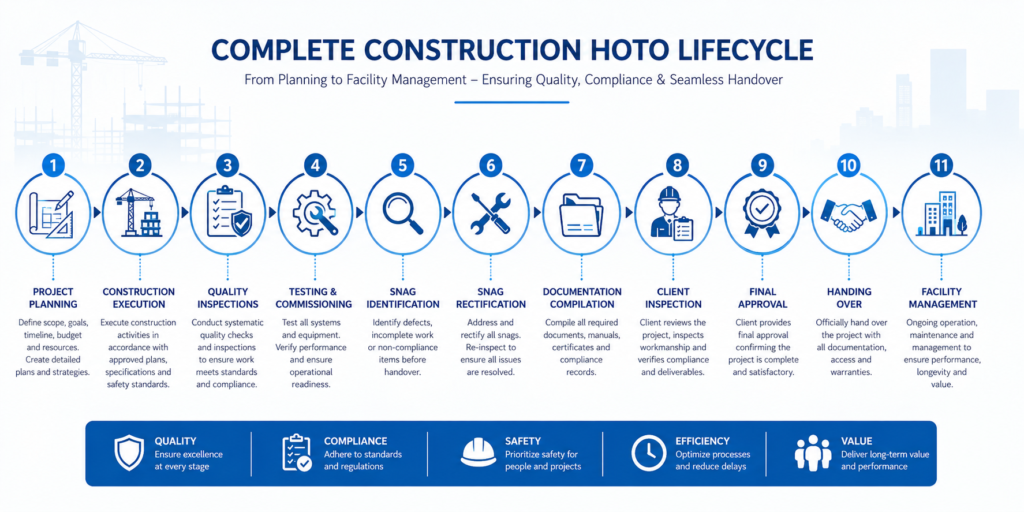
Who Is Involved in the HOTO Process?
Successful handover requires collaboration across multiple disciplines.
| Stakeholder | Key Responsibility |
|---|---|
| Project Manager | Coordinates the overall handover process |
| Site Engineer | Verifies physical completion of work |
| QA/QC Engineer | Ensures quality documentation is complete |
| Planning Engineer | Tracks project closeout milestones |
| MEP Engineer | Validates mechanical, electrical, and plumbing systems |
| Contractor | Compiles and submits handover documentation |
| Consultant | Reviews and approves deliverables |
| Client | Accepts the completed facility |
| Facility Management Team | Takes over operation and maintenance |
Each stakeholder plays a critical role in ensuring a seamless transition from construction to operations.
💡 Expert Insight
“The quality of your handover package often leaves a longer-lasting impression than the quality of your construction.”
A professional HOTO package demonstrates attention to detail, builds client confidence, and sets the foundation for efficient building operations.
What is Construction HOTO? The Complete Workflow, Documentation & Best Practices
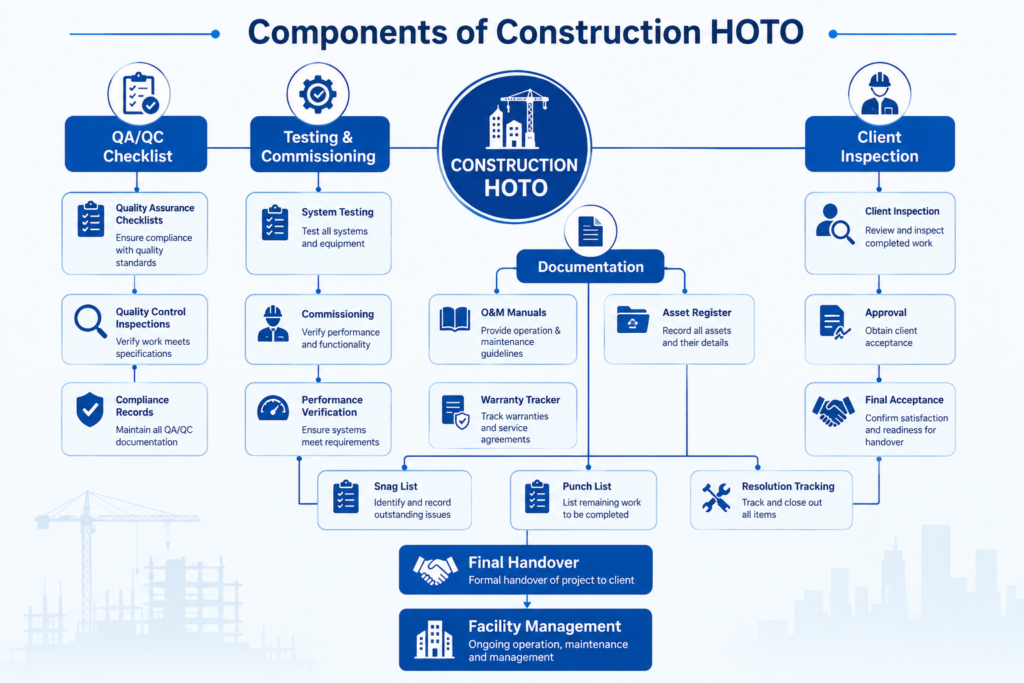
What is Construction HOTO?
The term HOTO (Handing Over & Taking Over) refers to the structured and documented process of transferring a completed construction project from the contractor to the client, owner, or facility management team.
It is much more than handing over keys or signing a completion certificate.
A professional HOTO process confirms that:
✅ Construction work is completed according to approved drawings.
✅ All systems have been inspected.
✅ Testing & Commissioning has been successfully completed.
✅ All QA/QC documents are approved.
✅ O&M Manuals are available.
✅ Warranty certificates are collected.
✅ Assets are registered.
✅ Snag items have been closed.
✅ The client has accepted the project.
Think of HOTO as the final quality audit of your project.
Without a structured handover process, even a well-built project can become difficult to maintain, operate, or legally close.
Why HOTO Is the Most Critical Phase of a Construction Project
Every project follows a similar lifecycle:
Planning
     │
     ▼
Design
     │
     ▼
Procurement
     │
     ▼
Construction
     │
     ▼
Quality Control
     │
     ▼
Testing & Commissioning
     │
     ▼
HOTO
     │
     ▼
Facility Management
Notice that HOTO is the bridge between construction and operations.
A successful HOTO ensures that:
- Clients receive a fully documented building.
- Facility managers understand how to operate equipment.
- Maintenance teams know warranty periods.
- Owners receive complete project records.
- Contractors can close the project efficiently.
Construction HOTO Workflow (Step-by-Step)
Professional construction companies generally follow a structured handover workflow consisting of ten stages.
Stage 1 – Practical Completion
The project reaches a stage where all major construction activities have been completed according to the contract.
Typical activities include:
- Structural completion
- Architectural finishes
- MEP installation
- External works
- Utility connections
At this point, the building appears complete, but documentation and verification are still ongoing.
Stage 2 – Internal Inspection
Before inviting consultants or clients, contractors perform detailed internal inspections.
The objective is to identify:
- Defects
- Missing works
- Damaged finishes
- Equipment issues
- Safety observations
This proactive step helps reduce comments during official inspections.
Stage 3 – QA/QC Verification
The Quality team verifies compliance with project specifications by reviewing:
- Material approvals
- Inspection Requests (IRs)
- Method Statements
- Test Reports
- Concrete Cube Results
- Calibration Certificates
- NCR Closures
Only compliant work should proceed to handover.
Stage 4 – Testing & Commissioning
Every installed system must be tested to confirm it operates as designed.
Examples include:
Electrical Systems
- Insulation Resistance Test
- Earth Resistance Test
- Functional Testing
HVAC
- Air Balancing
- Water Balancing
- Temperature Verification
Fire Fighting
- Pump Testing
- Hydrant Flow Test
- Fire Alarm Testing
Plumbing
- Pressure Testing
- Leak Testing
- Pump Performance Testing
Every test should be documented and approved.
Stage 5 – Documentation Compilation
This stage is often underestimated.
The contractor begins collecting every document required for project completion.
Typical documents include:
✔ Approved Drawings
✔ As-Built Drawings
✔ Material Approvals
✔ Inspection Reports
✔ Test Reports
✔ Manufacturer Certificates
✔ O&M Manuals
✔ Equipment Datasheets
✔ Warranty Certificates
✔ Calibration Reports
✔ Training Records
✔ Asset Register
✔ Commissioning Reports
A missing document at this stage can delay project handover significantly.
Essential Construction Handover Documents
| Document | Purpose | Mandatory |
|---|---|---|
| As-Built Drawings | Final construction record | ✅ |
| O&M Manuals | Future maintenance | ✅ |
| Asset Register | Facility Management | ✅ |
| Warranty Certificates | Equipment warranty | ✅ |
| Inspection Reports | Quality verification | ✅ |
| Test Reports | System validation | ✅ |
| Commissioning Reports | Operational readiness | ✅ |
| Training Records | User knowledge transfer | Recommended |
| Handover Certificate | Final acceptance | ✅ |
Stage 6 – Snag List Preparation
During client inspection, minor defects are identified.
Examples include:
- Paint touch-up
- Broken tile
- Damaged door closer
- Ceiling crack
- Loose switch plate
- Water leakage
- Missing labels
- Damaged silicone seal
Each issue should include:
- Description
- Location
- Responsible contractor
- Due date
- Status
- Remarks
Stage 7 – Punch List Closure
After snag rectification, consultants verify completion.
Only after every item is closed can the project proceed to final acceptance.
Snag List vs Punch List
One of the most common misconceptions among engineers is that snag lists and punch lists are the same.
Although similar, they serve different purposes.
| Snag List | Punch List |
|---|---|
| Identifies defects | Identifies remaining work |
| Quality related | Completion related |
| Generated during inspections | Generated before handover |
| Requires rectification | Requires completion |
| Usually created by consultants | Often created jointly |
Understanding this distinction improves project closeout planning.
Stage 8 – Client Inspection
The client performs a comprehensive review of the project.
Typical focus areas include:
- Overall workmanship
- Equipment functionality
- Documentation completeness
- Safety compliance
- Asset verification
- Operational readiness
Any remaining observations are recorded for closure.
Stage 9 – Final Approval
Once all comments are addressed, the consultant recommends the project for acceptance.
Required approvals may include:
- Consultant
- Client
- Project Manager
- QA/QC Manager
- Facility Management Representative
Stage 10 – Official Handover
The final stage includes:
✔ Handover Certificate
✔ Key Transfer
✔ Asset Transfer
✔ O&M Manual Submission
✔ Warranty Submission
✔ Training Completion
✔ Project Closeout
The project officially moves from construction to facility operation.
Traditional Handover vs Smart Digital HOTO
| Traditional Process | Smart Digital HOTO |
|---|---|
| Multiple spreadsheets | One centralized workbook |
| Paper checklists | Digital checklists |
| Manual updates | Live dashboard |
| Email attachments | Organized document repository |
| Difficult warranty tracking | Automated warranty tracker |
| Separate snag sheets | Integrated snag management |
| Manual reporting | Instant progress summaries |
| High risk of missing documents | Structured document control |
Digital systems significantly reduce administrative effort and improve transparency across project teams.
Discipline-Wise Construction HOTO Checklists (Civil, Architectural & Electrical)
Why Discipline-Wise Handover Checklists Matter
Imagine handing over a ₹100 crore commercial building.
The client walks through the building.
Everything looks perfect.
Suddenly, they discover:
❌ Emergency lights aren’t functioning.
❌ Fire doors don’t close properly.
❌ Basement waterproofing is leaking.
❌ Pump room labels are missing.
❌ Switchboards are not identified.
❌ Paint touch-ups remain unfinished.
Even though 99% of the project is complete, these seemingly minor issues can delay occupancy and damage client confidence.
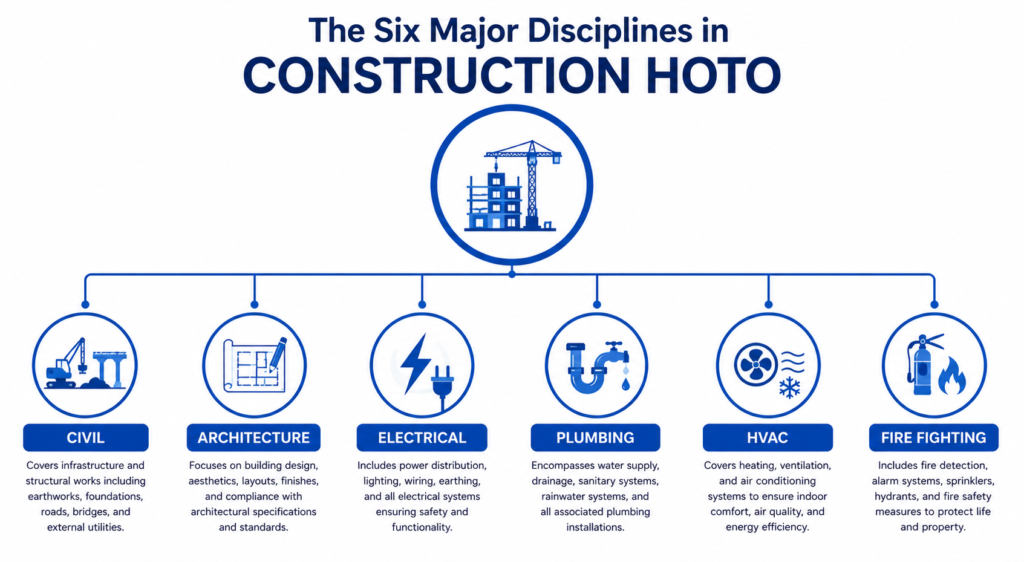
This is why successful construction companies don’t rely on memory—they rely on structured discipline-wise HOTO checklists.
A detailed checklist ensures that every engineer verifies their scope before the client arrives, reducing rework and accelerating project closeout.
CIVIL HOTO CHECKLIST
Why Civil Inspection Matters
Civil works form the structural foundation of every building.
Unlike finishes, many civil defects become expensive—or even impossible—to rectify after occupancy.
Proper inspection before handover ensures durability, safety, and long-term performance.
Major Civil Inspection Areas
1. Structural Works
Verify:
✅ Columns
✅ Beams
✅ Slabs
✅ Shear Walls
✅ Staircases
Check for:
- Honeycombing
- Surface cracks
- Concrete damage
- Exposed reinforcement
- Uneven finishes
2. Masonry
Inspect:
- Blockwork alignment
- Verticality
- Joint thickness
- Wall stability
- Corner finishing
Common Issues
❌ Uneven joints
❌ Hollow sounding blocks
❌ Cracks
❌ Poor alignment
3. Plastering
Verify:
- Smoothness
- Uniform thickness
- Hollow patches
- Corner finishing
- Surface cracks
Professional Tip
Always inspect plaster under natural daylight.
Small defects become highly visible after painting.
4. Waterproofing
Critical Areas
✔ Toilets
✔ Terrace
✔ Basement
✔ Lift Pits
✔ Water Tanks
Check:
- Leakage
- Ponding
- Joint sealing
- Membrane condition
5. Flooring
Inspect:
- Tile alignment
- Hollow tiles
- Grout quality
- Expansion joints
- Finish level
- Chipped edges
6. External Development
Verify
- Roads
- Kerbs
- Interlocking Pavers
- Drainage
- Landscaping
- Compound Wall
Civil Checklist Summary
| Inspection Item | Status |
|---|---|
| RCC Structure | □ |
| Masonry | □ |
| Plaster | □ |
| Waterproofing | □ |
| Flooring | □ |
| External Works | □ |
| Expansion Joints | □ |
| Surface Drainage | □ |
| Kerb Stones | □ |

ARCHITECTURAL HOTO CHECKLIST
Why Architectural Inspection Matters
Clients judge a project primarily by its finishes.
Even if the structural quality is excellent, poor architectural finishes can leave a negative impression.
Attention to detail during this stage directly impacts customer satisfaction.
Major Architectural Inspection Areas
Doors
Inspect
- Alignment
- Door closer operation
- Lock set
- Handles
- Hinges
- Door numbering
Windows
Check
- Smooth operation
- Silicone sealant
- Glass scratches
- Hardware
- Drain holes
Painting
Verify
- Shade consistency
- Roller marks
- Touch-ups
- Surface preparation
- Bubble formation
False Ceiling
Inspect
- Panel alignment
- Sagging
- Open joints
- Access panels
- Ceiling level
Flooring Finish
Check
- Color variation
- Tile lip-page
- Joint alignment
- Skirting finish
Joinery
Inspect
- Cabinets
- Wardrobes
- Kitchen Units
- Shelving
Verify
- Alignment
- Finish
- Lock operation
- Soft closing
Toilet Accessories
Check
- Mirrors
- Soap Dispensers
- Tissue Holders
- Grab Bars
- Urinals
- Wash Basins
Signage
Verify
- Exit Signs
- Room Numbers
- Fire Exit
- Floor Directory
- Emergency Signs
Common Architectural Defects
| Defect | Impact |
|---|---|
| Paint bubbles | Poor appearance |
| Tile lippage | Trip hazard |
| Glass scratches | Client rejection |
| Door misalignment | Functional issue |
| Missing sealant | Water leakage |
| Loose hardware | Maintenance issue |
ELECTRICAL HOTO CHECKLIST
Why Electrical Inspection Matters
Electrical systems are among the most critical building services.
Even a small wiring issue can result in safety hazards, equipment failure, or operational delays.
Every electrical component must be tested, documented, and approved before handover.
Main Electrical Systems
Main LT Panel
Verify
✔ Panel Labels
✔ Nameplates
✔ Earthing
✔ Busbars
✔ Cable Entry
✔ Panel Cleanliness
Distribution Boards
Inspect
- Circuit identification
- MCB operation
- Neutral bar
- Earthing
- Locking
Lighting
Verify
- Lux Levels
- Emergency Lighting
- Exit Lighting
- Sensor Operation
Earthing
Check
- Earth Resistance
- Connections
- Test Certificates
- Identification Tags
Cable Management
Inspect
- Cable trays
- Supports
- Labels
- Fire stopping
Generator System
Verify
- Auto Start
- Fuel Level
- Load Test
- Exhaust
- Battery
UPS
Inspect
- Backup Time
- Battery Condition
- Alarm Status
- Output Voltage
Emergency Systems
Verify
- Fire Alarm Interface
- Emergency Lighting
- Exit Signs
- UPS Supply
Electrical Testing Checklist
| Test | Required |
|---|---|
| Insulation Resistance | ✅ |
| Earth Resistance | ✅ |
| Continuity Test | ✅ |
| Functional Test | ✅ |
| Phase Sequence | ✅ |
| Load Test | ✅ |
| Voltage Drop | ✅ |
| Thermal Scan | Recommended |
Common Electrical Defects
❌ Loose Termination
❌ Missing Labels
❌ Incorrect Phase Sequence
❌ Improper Earthing
❌ Damaged Cable Tray
❌ Broken Switches
❌ Missing DB Schedule
Comparison – Traditional vs. BuildHab Digital HOTO
| Activity | Traditional Method | BuildHab Toolkit |
|---|---|---|
| Civil Inspection | Paper checklist | Digital checklist |
| Architectural Inspection | Multiple Excel sheets | Centralized workbook |
| Electrical Testing | Separate reports | Integrated tracker |
| Defect Tracking | Manual updates | Live status dashboard |
| Documentation | Email folders | Organized document control |
| Progress Monitoring | Manual follow-up | Visual dashboard |
Expert Tips for Engineers
Civil Engineers
- Conduct waterproofing inspections after 24–48 hours of ponding tests.
- Verify expansion joints before final flooring acceptance.
- Photograph hidden defects before they are concealed.
Architectural Engineers
- Inspect finishes under both natural and artificial lighting.
- Check every door and window for smooth operation.
- Confirm all signage matches approved drawings.
Electrical Engineers
- Label every distribution board and circuit clearly.
- Verify earthing resistance values against project specifications.
- Ensure emergency systems function during simulated power failures.
BuildHab Construction HOTO Master Toolkit – How It Helps
Managing discipline-wise inspections across multiple teams can quickly become overwhelming. The BuildHab Construction HOTO Master Toolkit simplifies this by providing:
- Pre-built Civil, Architectural, and Electrical checklists.
- Standardized inspection formats.
- Centralized defect tracking.
- Document control sheets.
- Progress dashboards.
- Easy customization for project-specific requirements.
Instead of maintaining separate spreadsheets for each discipline, your team can work from one structured system, reducing errors and improving visibility throughout the handover process.
MEP Handover, Testing & Commissioning, Asset Register, O&M Manuals & Warranty Management
From Construction Completion to Building Operation
By now, the civil, architectural, and electrical works are complete. However, a building cannot be occupied until all Mechanical, Electrical, Plumbing (MEP), Fire Protection, and Life Safety Systems have been thoroughly tested, commissioned, documented, and handed over.
Think of it this way:
Construction builds the building. MEP brings the building to life.
Without functioning building services, a completed structure is simply an empty shell.
MEP Handover Process
Equipment Installation
        │
        ▼
Visual Inspection
        │
        ▼
Pre-Commissioning
        │
        ▼
Testing
        │
        ▼
Commissioning
        │
        ▼
Performance Verification
        │
        ▼
Documentation
        │
        ▼
Client Demonstration
        │
        ▼
Final Acceptance
Plumbing HOTO Checklist
Why Plumbing Inspection is Critical
A small water leak today can become a major structural problem tomorrow.
Plumbing systems must be inspected, tested, and documented before occupancy to ensure long-term reliability.
Water Supply System
Inspect:
✔ Pipe Supports
✔ Pipe Identification
✔ Valve Labels
✔ Pressure Gauges
✔ Pipe Insulation
✔ Flexible Connections
Pressure Testing
Verify:
- Design Pressure
- Test Duration
- Leakage
- Pressure Drop
- Test Report Approval
Drainage System
Inspect:
- Floor Traps
- Clean-outs
- Drainage Slope
- Pipe Supports
- Access Chambers
- Vent Pipes
Pumps
Verify:
- Rotation Direction
- Flow Rate
- Pressure
- Vibration
- Noise
- Motor Current
- Auto Operation
Water Tanks
Inspect:
- Internal Cleaning
- Overflow Pipe
- Ventilation
- Access Ladder
- Level Sensors
- Float Valve
Plumbing Checklist Summary
| Item | Status |
|---|---|
| Water Supply | □ |
| Drainage | □ |
| Pressure Test | □ |
| Pump Testing | □ |
| Water Tank | □ |
| Pipe Supports | □ |
| Valve Identification | □ |
HVAC HOTO Checklist
Why HVAC Commissioning Matters
HVAC systems account for a significant portion of a commercial building’s energy consumption. Proper commissioning ensures:
- Comfortable indoor conditions
- Efficient energy use
- Reduced maintenance costs
- Improved occupant satisfaction
Air Handling Units (AHUs)
Inspect:
- Filters
- Fan Rotation
- Belt Tension
- Dampers
- Motor Alignment
- Coil Cleanliness
- Drain Tray
Duct-work
Verify:
- Air Leakage
- Insulation
- Supports
- Access Panels
- Fire Dampers
- Flexible Connections
Chillers
Inspect:
- Oil Levels
- Refrigerant Pressure
- Temperature Differential
- Pump Operation
- Safety Controls
Diffusers & Grilles
Verify:
- Airflow
- Balancing
- Position
- Cleanliness
- Noise Levels
HVAC Performance Testing
Required tests include:
✔ Air Balancing
✔ Water Balancing
✔ Static Pressure
✔ Temperature Differential
✔ Air Velocity
✔ Noise Measurement
✔ Vibration Analysis
HVAC Checklist Summary
| Inspection Item | Status |
|---|---|
| AHU Inspection | □ |
| FCU Inspection | □ |
| Chiller Testing | □ |
| Air Balancing | □ |
| Duct Leakage | □ |
| Temperature Test | □ |
Fire Fighting HOTO Checklist
Fire Protection Saves Lives
Fire protection systems are not only contractual requirements—they are life safety systems.
Every component must function flawlessly before occupancy.
Fire Pump Room
Inspect:
✔ Main Pump
✔ Jockey Pump
✔ Diesel Pump
✔ Pressure Gauges
✔ Controller Panels
✔ Fuel Tank
Sprinkler System
Verify:
- Sprinkler Heads
- Pipe Supports
- Pressure
- Coverage
- Identification
Hydrant System
Inspect:
- Landing Valves
- Hose Reels
- Cabinets
- Branch Pipes
- Water Pressure
Fire Alarm System
Verify:
- Smoke Detectors
- Heat Detectors
- Manual Call Points
- Alarm Panels
- Sounders
- Strobes
Emergency Exit System
Inspect:
- Exit Signage
- Emergency Lighting
- Escape Route Marking
- Battery Backup
Fire Fighting Checklist Summary
| Item | Status |
|---|---|
| Fire Pumps | □ |
| Hydrant System | □ |
| Sprinklers | □ |
| Fire Alarm | □ |
| Exit Lighting | □ |
| Emergency Signage | □ |
Testing & Commissioning Tracker
What is Testing & Commissioning?
Testing verifies that individual equipment works.
Commissioning verifies that the complete building system works together.
Think of testing as checking individual musicians, while commissioning ensures the entire orchestra performs in harmony.
Typical Testing Activities
| Discipline | Test |
|---|---|
| Electrical | Insulation Resistance |
| Plumbing | Pressure Test |
| HVAC | Air Balancing |
| Fire Fighting | Pump Flow Test |
| Generator | Load Test |
| UPS | Backup Test |
| Lifts | Functional Test |
| DG Synchronization | Performance Test |
Commissioning Workflow
Installation
      │
      ▼
Inspection
      │
      ▼
Testing
      │
      ▼
Rectification
      │
      ▼
Retesting
      │
      ▼
Commissioning
      │
      ▼
Approval
Asset Register
Why Every Building Needs an Asset Register
Imagine trying to maintain 5,000 pieces of equipment without knowing:
- Manufacturer
- Installation Date
- Model Number
- Warranty
- Location
That’s why an asset register is one of the most valuable handover documents.
Recommended Asset Information
| Field | Example |
|---|---|
| Asset ID | AHU-01 |
| Description | Air Handling Unit |
| Manufacturer | Carrier |
| Serial Number | 2026AHU001 |
| Location | Basement Plant Room |
| Installation Date | 15 Jan 2026 |
| Warranty | 24 Months |
| Maintenance Frequency | Quarterly |
O&M Manual Tracker
What is an O&M Manual?
The Operation & Maintenance Manual explains how to operate, inspect, troubleshoot, and maintain equipment safely throughout its lifecycle.
Without it, facility teams rely on guesswork.
O&M Manual Should Include
✔ Operating Instructions
✔ Maintenance Procedures
✔ Spare Parts
✔ Troubleshooting
✔ Safety Guidelines
✔ Emergency Shutdown Procedure
✔ Manufacturer Contacts
✔ Service Schedule
Warranty Tracker
Why Warranty Tracking Matters
Many organizations lose warranty coverage simply because they don’t know when it expires.
A warranty tracker should include:
| Equipment | Warranty Start | Expiry | Vendor |
|---|---|---|---|
| Chiller | Jan 2026 | Jan 2028 | ABC HVAC |
| Generator | Feb 2026 | Feb 2029 | XYZ Power |
| Fire Pump | Mar 2026 | Mar 2028 | SafeFire Ltd. |
With a centralized tracker, teams can schedule maintenance, raise claims promptly, and avoid unnecessary repair costs.
The BuildHab Advantage
Instead of maintaining separate spreadsheets for plumbing, HVAC, fire systems, commissioning records, assets, warranties, and O&M manuals, the BuildHab Construction HOTO Master Toolkit centralizes everything in one place.
Included Modules
- Plumbing HOTO Checklist
- HVAC HOTO Checklist
- Fire Fighting Checklist
- Testing & Commissioning Tracker
- Asset Register
- O&M Manual Tracker
- Warranty Tracker
- Interactive Dashboard
- Document Control Register
This integrated approach improves collaboration between contractors, consultants, clients, and facility management teams while reducing the risk of missing documentation.
Expert Tips
📌 Start documentation early. Waiting until the end of the project creates unnecessary pressure and increases the chance of missing records.
📌 Assign ownership. Each discipline should have a dedicated engineer responsible for completing and verifying their handover documents.
📌 Use standardized templates. Consistent formats make reviews faster and reduce confusion.
📌 Digitize your process. Centralized tracking improves transparency, accountability, and project closeout efficiency.
Snag Management, Final Handover, BuildHab Toolkit, FAQs & Conclusion
Snag List Management – The Final Quality Check
As construction nears completion, minor defects—commonly called snags—are almost inevitable. The key to a successful handover is not avoiding every snag, but identifying, tracking, and closing them systematically before the client takes possession.
A well-managed snag list helps:
- Deliver a polished project.
- Reduce repeat inspections.
- Improve client satisfaction.
- Minimize post-handover complaints.
- Speed up final approvals.
Common Snag Items
Civil
- Concrete cracks
- Honeycombing
- Surface damage
- Uneven flooring
- Waterproofing leaks
Architectural
- Paint touch-ups
- Door alignment
- Glass scratches
- Missing silicone
- Damaged skirting
Electrical
- Missing labels
- Loose switches
- Faulty emergency lights
- Incomplete DB schedules
Plumbing
- Water leakage
- Incorrect slope
- Loose fixtures
- Valve identification missing
HVAC
- Air leakage
- Poor balancing
- High vibration
- Condensation
Fire Fighting
- Improper sprinkler spacing
- Alarm faults
- Pressure issues
- Missing signage
Professional Snag Workflow
Inspection
      │
      ▼
Snag Identified
      │
      ▼
Assign Responsible Engineer
      │
      ▼
Rectification
      │
      ▼
Quality Verification
      │
      ▼
Consultant Approval
      │
      ▼
Snag Closed
Punch List Management
While snag lists focus on defects, punch lists concentrate on remaining contractual work that must be completed before final acceptance.
Examples include:
- Missing room numbers.
- Final equipment labeling.
- Cleaning.
- Landscaping completion.
- Ceiling tile replacement.
- Safety signage installation.
- Access panel installation.
Recommended Punch List Tracker
| ID | Location | Description | Assigned To | Due Date | Status |
|---|---|---|---|---|---|
| P-001 | Lobby | Install Exit Sign | Electrical | 12/07/26 | Open |
| P-002 | Roof | Seal Expansion Joint | Civil | 14/07/26 | Closed |
| P-003 | Pump Room | Label Valves | Plumbing | 13/07/26 | In Progress |
Final Handover Documentation Package
A professional HOTO package should contain the following documents:
| Document | Purpose |
|---|---|
| As-Built Drawings | Final construction record |
| Approved Shop Drawings | Reference documentation |
| Material Approvals | Quality verification |
| QA/QC Records | Inspection history |
| Testing & Commissioning Reports | Operational verification |
| Asset Register | Facility management |
| O&M Manuals | Equipment maintenance |
| Warranty Certificates | Warranty claims |
| Snag Register | Defect tracking |
| Punch List | Remaining works |
| Training Records | Knowledge transfer |
| Handover Certificate | Official project transfer |
BuildHab Construction HOTO Master Toolkit
Managing hundreds of documents across multiple teams can quickly become overwhelming. The BuildHab Construction HOTO Master Toolkit is designed to bring every critical handover activity into one structured Excel-based system.
What’s Included
- Civil HOTO Checklist
- Architectural HOTO Checklist
- Electrical HOTO Checklist
- Plumbing HOTO Checklist
- HVAC HOTO Checklist
- Fire Fighting Checklist
- Testing & Commissioning Tracker
- Asset Register
- O&M Manual Tracker
- Warranty Tracker
- Snag List Tracker
- Punch List Tracker
- Handover Certificate Template
- Interactive Dashboard
- Document Control Register
- User Guide
Why Choose the BuildHab Toolkit?
| Traditional Handover | BuildHab Toolkit |
|---|---|
| Multiple spreadsheets | One centralized workbook |
| Manual tracking | Automated dashboards |
| Disorganized documents | Structured document control |
| Difficult progress monitoring | Live status overview |
| Separate discipline records | Integrated workflow |
| Higher risk of missing documents | Standardized templates |
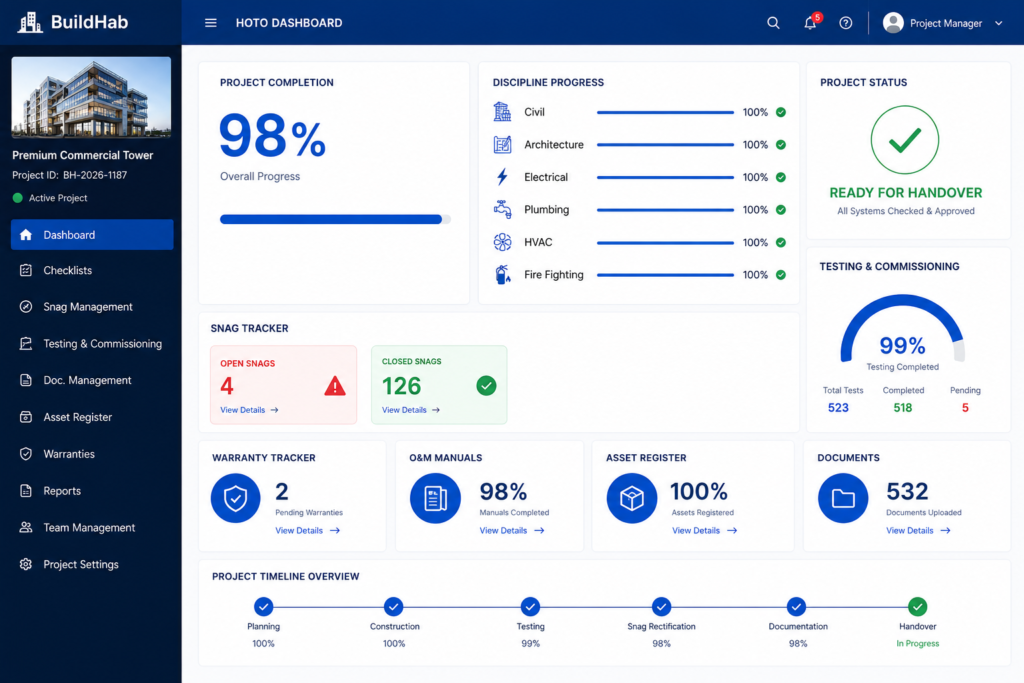
Real-World Example
Project: Commercial Office Tower
Challenges Before Handover
- More than 800 documents stored across different folders.
- Multiple spreadsheet versions causing confusion.
- Delays in locating warranty certificates.
- Snag items tracked through email.
- No centralized dashboard.
After Using a Structured HOTO Toolkit
- All handover documents organized in one workbook.
- Discipline-wise progress visible at a glance.
- Faster consultant reviews.
- Improved coordination between QA/QC, MEP, and project teams.
- Reduced administrative effort during project closeout.
This example illustrates how a standardized approach can streamline the handover process and reduce documentation-related delays.
Best Practices for Successful Construction Handover
- Begin documentation from the early stages of the project.
- Conduct internal audits before inviting the client.
- Use standardized checklists across all disciplines.
- Update snag and punch lists daily.
- Verify testing and commissioning reports before submission.
- Train the facility management team before occupancy.
- Keep warranties and O&M manuals complete and organized.
- Maintain strict document version control.
- Review the entire handover package before the final inspection.
Frequently Asked Questions
What is HOTO in construction?
HOTO stands for Handing Over and Taking Over, the formal process of transferring a completed construction project from the contractor to the client or facility management team.
What documents are required for project handover?
A complete package typically includes:
- As-built drawings
- QA/QC records
- Testing and commissioning reports
- O&M manuals
- Warranty certificates
- Asset register
- Snag list
- Punch list
- Handover certificate
What is the difference between a snag list and a punch list?
A snag list records defects that require rectification, while a punch list records remaining work items that must be completed before final acceptance.
Why is an asset register important?
An asset register provides detailed information about equipment, including location, serial numbers, maintenance schedules, and warranty periods, helping facility managers operate and maintain the building efficiently.
Why are O&M manuals essential?
They provide operating instructions, maintenance procedures, troubleshooting guidance, and safety information, enabling effective long-term management of building systems.
Can the BuildHab Toolkit be customized?
Yes. The Excel-based format allows project teams to tailor checklists, trackers, and dashboards to suit specific project requirements and organizational standards.
Final Thoughts
A successful construction project is defined not only by its physical completion but also by the quality of its handover. Every checklist completed, every test documented, and every warranty organized contributes to a smoother transition from construction to operation.
By adopting a structured HOTO process, project teams can reduce delays, improve collaboration, and deliver greater value to clients. Whether you’re managing a residential development, commercial complex, industrial facility, or infrastructure project, investing time in organized handover documentation pays dividends throughout the building’s lifecycle.
The BuildHab Construction HOTO Master Toolkit has been developed to simplify this journey by combining discipline-wise checklists, testing and commissioning trackers, asset management, warranty monitoring, O&M documentation, snag and punch list tracking, and interactive dashboards into one comprehensive solution.
Download the BuildHab Construction HOTO Master Toolkit
Ready to transform your construction handover process?
✔ Standardized HOTO checklists
✔ Centralized documentation
✔ Smart project dashboards
✔ Asset & warranty tracking
✔ QA/QC ready templates
✔ Professional Excel-based system
👉 Download the BuildHab Construction HOTO Master Toolkit today and deliver every project with confidence, clarity, and professionalism.


Pingback: How AI Is Revolutionizing Construction Quality Management in 2026 - qualconn How AI is Transforming Construction Quality Management in 2026
Pingback: Important Flat Handover Checks & Legal Documents to Protect Your Home - qualconn