Waterproofing is one of the most important activities in construction because water leakage can damage a structure faster than many other defects. Poor waterproofing leads to seepage, dampness, paint peeling, steel corrosion, fungal growth, and expensive maintenance costs. Whether it is a residential building, commercial project, basement, terrace, or bathroom, proper waterproofing inspection is essential for long-term durability.
For civil engineers, QA/QC engineers, consultants, and site supervisors, understanding waterproofing quality checks helps prevent future complaints and ensures better project performance. A small mistake during surface preparation, membrane application, or testing can cause major leakage issues after project handover.
This detailed guide explains the most important waterproofing quality checks every engineer must know, including inspection procedures, common defects, testing methods, and best practices used on construction sites.
Why Waterproofing Quality Checks Are Important
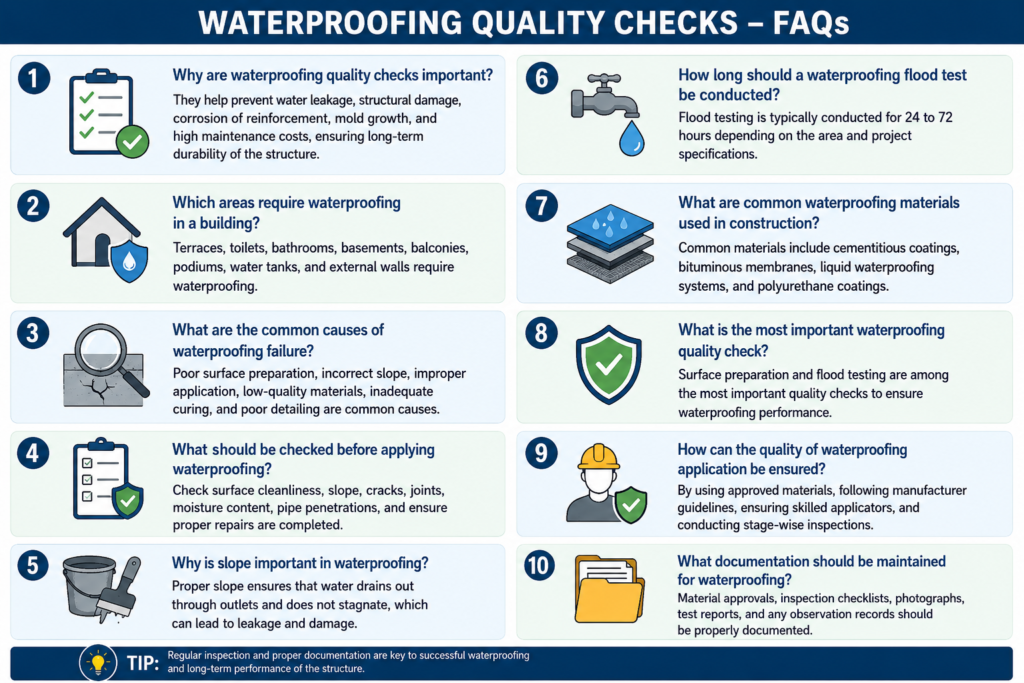
Waterproofing failures are among the most common defects found in buildings. In many projects, leakage problems appear within a few months because of poor workmanship, improper material application, or lack of inspection.
Proper waterproofing quality checks help to:
- Prevent water seepage and dampness
- Protect reinforcement from corrosion
- Increase structural durability
- Reduce maintenance and repair costs
- Improve customer satisfaction
- Prevent mold and fungal growth
- Avoid paint and plaster damage
- Increase building life
Without proper waterproofing inspection, even high-quality construction can fail due to continuous water exposure.
Areas Where Waterproofing Is Commonly Required
Different building components require different waterproofing systems. Engineers must understand the requirements of each area before inspection.
Terrace Waterproofing
Terraces are continuously exposed to rainwater and sunlight. Poor slope, cracks, or damaged membranes can cause roof leakage.
Toilet and Bathroom Waterproofing
Bathrooms are constantly exposed to water. Improper waterproofing can cause leakage to lower floors and adjacent walls.
Basement Waterproofing
Basements face groundwater pressure and are highly vulnerable to seepage through retaining walls and slabs.
Water Tank Waterproofing
Underground and overhead water tanks require waterproofing to prevent leakage and contamination.
Balcony and Podium Waterproofing
Water stagnation in balconies and podium slabs can lead to seepage and concrete deterioration.
External Wall Waterproofing
External walls are exposed to rainwater, cracks, and thermal expansion.
Types of Waterproofing Systems Used in Construction
Before performing inspections, engineers should understand the waterproofing system used in the project.
Cementitious Waterproofing
This system is commonly used in bathrooms, kitchens, toilets, and water tanks.
Advantages
- Easy application
- Good bonding with concrete
- Economical solution
Limitations
- Less flexible under structural movement
Bituminous Membrane Waterproofing
Widely used for terraces, podiums, and basements.
Advantages
- Excellent water resistance
- Durable performance
- Good flexibility
Limitations
- Requires skilled workmanship
- Vulnerable to puncture damage
Liquid Waterproofing Membrane
A liquid coating is applied using rollers or brushes to form a seamless waterproof layer.
Advantages
- Seamless application
- Easy maintenance
- Good flexibility
Polyurethane Waterproofing
Used in terraces and exposed roofs requiring high flexibility.
Advantages
- Excellent crack-bridging capability
- High durability
- Strong adhesion
Pre-Waterproofing Inspection Checks
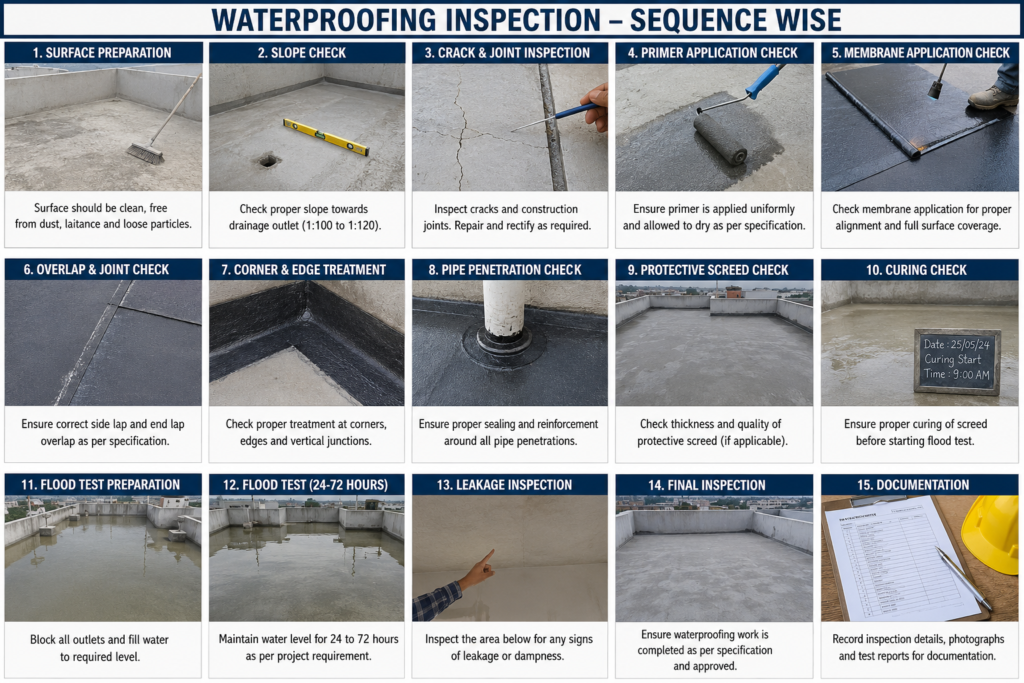
Waterproofing quality starts before material application. Engineers must inspect the surface carefully.
Surface Cleaning
The substrate should be clean and free from:
- Dust
- Oil
- Loose particles
- Cement laitance
- Debris
Dirty surfaces reduce bonding and may cause membrane failure.
Concrete Surface Condition
Inspect the concrete for:
- Honeycombing
- Surface cracks
- Voids
- Uneven areas
- Segregation
Defective concrete must be repaired before waterproofing application.
Slope Verification
Improper slope causes water stagnation, leading to leakage.
Recommended slope:
- Terrace: 1:100 to 1:120
- Toilets: Proper slope towards floor traps
Use leveling instruments to verify slope before waterproofing work.
Joint Inspection
Construction joints, expansion joints, and pipe penetrations are common leakage points.
Ensure:
- Joints are properly sealed
- Groove cutting is completed
- Sealants are applied correctly
Moisture Content Check
Some waterproofing systems require dry surfaces before application.
Excess moisture may:
- Reduce bonding
- Cause blistering
- Lead to membrane peeling
Waterproofing Material Quality Checks
Using poor-quality materials is one of the major causes of waterproofing failure.
Check Manufacturer Approval
Ensure materials are approved according to project specifications and consultant requirements.
Verify Batch Number and Manufacturing Date
Expired materials should never be used.
Check:
- Manufacturing date
- Expiry date
- Batch consistency
Storage Inspection
Waterproofing materials should be stored properly.
Inspect for:
- Protection from sunlight
- Dry storage conditions
- Closed containers
- No material contamination
Improper storage affects material performance.
Waterproofing Application Quality Checks
Application quality directly affects waterproofing performance.
Primer Application Inspection
Ensure:
- Proper primer coverage
- Uniform application
- Required drying time before membrane installation
Poor priming reduces adhesion.
Membrane Thickness Check
Membrane thickness should match project specifications.
Uneven thickness can cause weak points and leakage.
Use:
- Wet film thickness gauges
- Random thickness inspection
Overlap Inspection
For membrane waterproofing:
- Side overlaps should be proper
- End laps must be sealed correctly
- No open joints should remain
Improper overlap is a common leakage source.
Air Bubble Inspection
Air pockets below membranes can lead to failure.
Inspect for:
- Blisters
- Air gaps
- Improper bonding
Remove and repair defective areas immediately.
Reinforcement Mesh Placement
In some systems, fiberglass mesh or reinforcing fabric is used.
Ensure:
- Proper embedding
- No wrinkles
- Complete coverage
Pipe Penetration Waterproofing
Pipe junctions are highly vulnerable leakage locations.
Check:
- Additional reinforcement
- Sealant application
- Collar fixing
- Tight sealing around pipes
Corner and Joint Treatment
Corners and joints require extra care because cracks often develop at these locations.
Inspect:
- Cove formation
- Sealant application
- Reinforcement at corners
Waterproofing Quality Checks for Toilets
Toilet leakage is one of the most common defects in residential projects.
Toilet Waterproofing Inspection Checklist
Surface Preparation
- Floor cleaned properly
- Loose concrete removed
- Cracks repaired
Pipe Sleeve Inspection
- Pipe sleeves fixed correctly
- Gaps sealed properly
Waterproof Coating Check
- Uniform coating thickness
- Multiple coats applied
- Proper curing maintained
Wall Waterproofing Height
Waterproofing should extend:
- Minimum 300 mm on walls
- Up to 1800 mm in shower areas
Flood Test
Flood testing is mandatory before tile installation.
Water should be stored for:
- 24 to 72 hours
Inspect the lower slab for leakage during testing.
Terrace Waterproofing Quality Checks
Terrace leakage can severely damage interiors and ceilings.
Important Terrace Waterproofing Checks
Slope Inspection
Ensure proper drainage slope towards rainwater outlets.
Drainage Outlet Inspection
Check:
- Outlet positioning
- Blockage prevention
- Proper sealing
Membrane Continuity
Ensure continuous waterproof layer without gaps.
Protective Screed Inspection
Protective screed prevents membrane damage.
Inspect for:
- Proper thickness
- Crack-free surface
- Adequate curing
Expansion Joint Treatment
Expansion joints should have:
- Flexible sealants
- Proper joint covering systems
Basement Waterproofing Quality Checks
Basement waterproofing requires special attention due to hydro static pressure.
Raft and Retaining Wall Inspection
Check:
- Construction joints
- Kickers
- Honeycombing
- Tie rod holes
Water Stopper Inspection
PVC or rubber water stoppers should be:
- Correctly positioned
- Properly fixed
- Free from displacement
Protection Board Inspection
Protection boards prevent membrane damage during backfilling.
Ensure:
- Complete membrane coverage
- No punctures
- Proper fixing
Waterproofing Testing Methods
Testing verifies waterproofing performance before finishing works.
Flood Testing
Most commonly used for toilets and terraces.
Procedure
- Block drainage outlets
- Fill area with water
- Maintain water level for 24–72 hours
- Inspect for leakage
Ponding Test
Used for terrace waterproofing.
Observe:
- Water stagnation
- Leakage points
- Surface settlement
Electronic Leak Detection
Advanced projects use electronic systems to identify membrane defects.
Water Spray Test
Used for external wall waterproofing inspection.
Continuous water spraying helps identify seepage points.
Common Waterproofing Defects and Causes
Understanding common failures helps engineers improve inspection quality.
Cracks in Waterproof Layer
Causes
- Structural movement
- Improper curing
- Poor material quality
Membrane Peeling
Causes
- Improper surface cleaning
- Moisture on substrate
- Poor adhesion
Water Stagnation
Causes
- Incorrect slope
- Blocked drainage outlets
Leakage Through Pipe Joints
Causes
- Improper sealing
- Inadequate reinforcement
Blister Formation
Causes
- Trapped moisture
- Air pockets under membrane
Best Practices for Waterproofing Quality Control
Following best practices improves waterproofing performance significantly.
Use Approved Materials
Always use project-approved waterproofing systems.
Train Skilled Applicators
Waterproofing quality depends heavily on workmanship.
Follow Manufacturer Guidelines
Application methods should match manufacturer recommendations.
Conduct Stage-Wise Inspection
Inspect:
- Before application
- During application
- After completion
Maintain Inspection Records
Document:
- Material approvals
- Test reports
- Inspection checklists
- Photographs
Safety Precautions During Waterproofing Work
Engineers should ensure worker safety during waterproofing activities.
Important Safety Measures
- Use PPE kits
- Ensure proper ventilation
- Avoid open flames near bitumen
- Use safety harnesses at height
- Store chemicals safely
Conclusion
Waterproofing quality checks are essential for ensuring durable and leakage-free structures. Even a small mistake during waterproofing application can lead to major structural damage, customer complaints, and expensive repairs in the future.
Civil engineers, QA/QC engineers, and site supervisors must inspect every stage carefully — from surface preparation and material storage to membrane application and testing. Proper slope, joint treatment, membrane thickness, and flood testing are some of the most critical inspection activities that should never be ignored.
By following systematic waterproofing inspection procedures and using high-quality materials, engineers can significantly improve building performance, durability, and long-term customer satisfaction.
Strong waterproofing quality control not only protects the structure but also enhances the overall reputation of the construction project.
FAQs on Waterproofing Quality Checks
What is the most important waterproofing quality check?
Surface preparation and flood testing are among the most critical waterproofing quality checks.
Why is flood testing important in waterproofing?
Flood testing helps identify leakage before tile work or finishing activities begin.
What causes waterproofing failure in buildings?
Common causes include poor workmanship, incorrect slope, improper surface cleaning, and low-quality materials.
Which areas require waterproofing in a building?
Terraces, toilets, basements, balconies, external walls, and water tanks require waterproofing.
How long should a waterproofing flood test be conducted?
Typically, flood testing is conducted for 24 to 72 hours depending on project specifications.
What are common waterproofing materials used in construction?
Common materials include cementitious coatings, bituminous membranes, polyurethane coatings, and liquid waterproofing systems.