
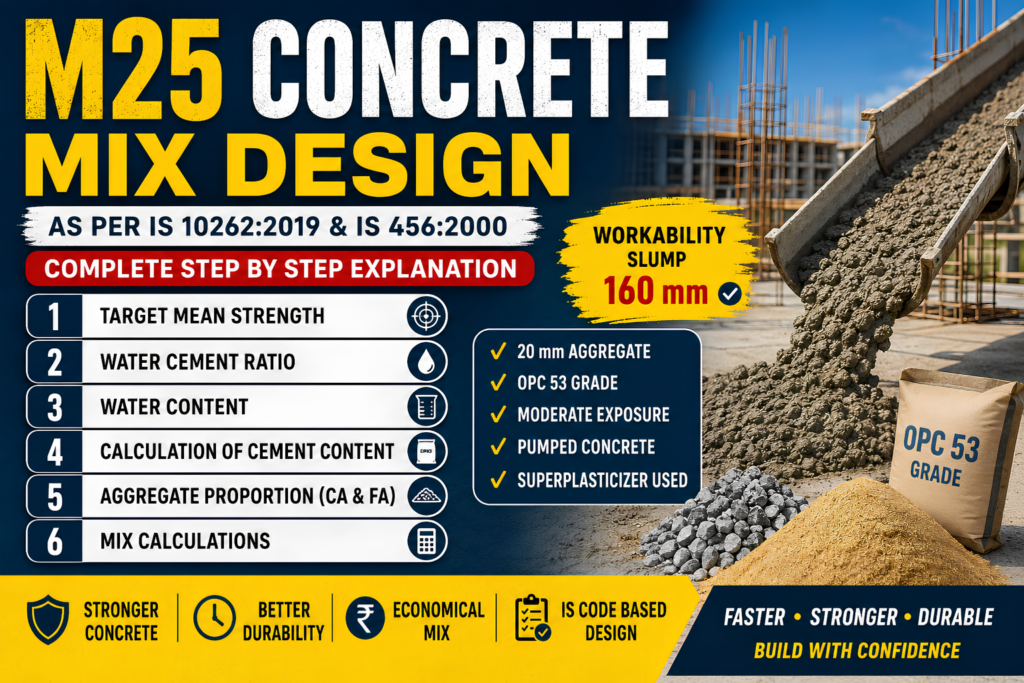
M25 Concrete Mix Design as per IS 10262:2019 is the standard procedure for determining the optimum proportions of cement, water, fine aggregate, coarse aggregate, and admixtures to achieve the required strength, workability, and durability. Since M25 is a design mix concrete, it must be proportioned scientifically rather than using nominal mix ratios.
Meaning of M25 Concrete
M25 concrete is a nominal grade designation where:
- M = Mix or Grade of Concrete
- 25 = Characteristic compressive strength of 25 MPa (N/mm²) at 28 days
The characteristic strength means that 95% of test results should achieve at least 25 MPa, while only 5% of results may fall below this value under standard testing conditions.
According to IS 456:2000, M25 falls under the Standard Grade Concrete category and is commonly used in reinforced concrete (RCC) structures.
Key Properties
| Parameter | Value |
|---|---|
| Grade | M25 |
| Characteristic Strength (fck) | 25 MPa |
| Age of Testing | 28 Days |
| Concrete Type | Standard Grade |
| Common Use | RCC Buildings & Infrastructure |
Why Mix Design is Required
Concrete is made from:
- Cement
- Fine Aggregate (Sand)
- Coarse Aggregate
- Water
- Admixtures (if required)
Simply mixing these materials without calculations may lead to:
- Low strength
- Honeycombing
- Excess cement consumption
- Segregation
- Bleeding
- Poor durability
A proper mix design ensures that all ingredients are proportioned scientifically to achieve the desired performance.
Objectives of Mix Design
Achieve Target Strength
Concrete should reach the required compressive strength after 28 days.
Ensure Durability
The mix should withstand environmental conditions such as moisture, sulphates, chlorides, and weathering.
Provide Adequate Workability
Concrete should be easy to place, compact, and finish without segregation.
Optimize Cement Content
Mix design avoids unnecessary cement consumption, reducing project costs.
Maintain Quality Consistency
Proper proportioning ensures consistent concrete quality throughout construction.
Improve Long-Term Performance
Well-designed concrete exhibits:
- Lower permeability
- Reduced cracking
- Better resistance to chemicals
- Increased service life
IS Codes Applicable for M25 Mix Design
Several Indian Standards are used together during concrete mix design.
| IS Code | Title | Purpose |
|---|---|---|
| IS 10262:2019 | Concrete Mix Proportioning – Guidelines | Mix design procedure |
| IS 456:2000 | Plain and Reinforced Concrete | Durability and design requirements |
| IS 383 | Coarse and Fine Aggregates | Aggregate quality requirements |
| IS 9103 | Chemical Admixtures | Admixture specifications |
| IS 1199 | Sampling and Testing of Fresh Concrete | Workability and fresh concrete testing |
Design Data for M25 Concrete Mix Design (As per IS 10262:2019)
| Particular | Value | Reference |
|---|---|---|
| Grade of Concrete | M25 | IS 456:2000 |
| Characteristic Compressive Strength (fck) | 25 MPa | IS 456:2000 |
| Maximum Nominal Size of Aggregate | 20 mm | IS 10262:2019 |
| Type of Cement | OPC 53 Grade | IS 269 / IS 12269 |
| Exposure Condition | Moderate | IS 456:2000, Table 3 |
| Minimum Cement Content | 300 kg/m³ | IS 456:2000, Table 5 |
| Maximum Cement Content | 450 kg/m³ | IS 456:2000, Clause 8.2.4.2 |
| Maximum Water-Cement Ratio | 0.50 | IS 456:2000, Table 5 |
| Desired Slump | 160 mm | Project Requirement (within IS 456 workability guidance) |
| Method of Transportation | Transit Mixer / Transportation Time: 45 minutes | Project Requirement |
| Method of Placing | Pumped Concrete | Project Requirement |
| Type of Coarse Aggregate | Crushed Angular Aggregate | IS 10262:2019 |
| Fine Aggregate Zone | Zone II | IS 383 |
| Degree of Quality Control | Good | IS 10262:2019 |
| Standard Deviation (S) | 4.0 MPa (N/mm²) | IS 10262:2019, Table 2 |
Material Test Data for M25 Concrete Mix Design
The physical properties of the constituent materials used in the concrete mix design shall be determined in accordance with the relevant Indian Standards before commencing the mix design calculations.
| Property | Value | Applicable IS Code |
|---|---|---|
| Specific Gravity of Cement (OPC 53 Grade) | 3.16 | IS 4031 (Part 11):1988 – Methods of Physical Tests for Hydraulic Cement – Determination of Density (Specific Gravity) |
| Specific Gravity of Fine Aggregate | 2.46 | IS 2386 (Part 3):1963 – Methods of Test for Aggregates for Concrete – Specific Gravity, Density, Voids, Absorption and Bulking |
| Specific Gravity of Coarse Aggregate | 2.73 | IS 2386 (Part 3):1963 – Methods of Test for Aggregates for Concrete – Specific Gravity, Density, Voids, Absorption and Bulking |
| Specific Gravity of Water | 1.00 | Standard Value (Used in IS 10262:2019 Absolute Volume Method) |
| Chemical Admixture | Superplasticizer | IS 9103:1999 (Reaffirmed) – Specification for Concrete Admixtures |
Recommended Aggregate Moisture Properties
When actual laboratory test results are not available, IS 10262:2019 permits the use of assumed values for preliminary mix design. However, the final mix should always be corrected using the actual measured moisture content and water absorption of the aggregates at the batching plant.
| Property | Recommended Value | Applicable IS Code |
|---|---|---|
| Water Absorption of Fine Aggregate | 1.0 % | IS 2386 (Part 3):1963 |
| Water Absorption of Coarse Aggregate | 0.5 % | IS 2386 (Part 3):1963 |
| Moisture Content of Fine Aggregate | 2.0 % (Typical for moist sand) | IS 2386 (Part 3):1963 |
| Moisture Content of Coarse Aggregate | 0.5 % | IS 2386 (Part 3):1963 |
Note: The above values are typical assumptions commonly adopted for trial mix calculations. Actual water absorption and moisture content should be determined by laboratory testing in accordance with IS 2386 (Part 3):1963 before production batching.
Summary of Material Properties
| Material | Property | Value |
|---|---|---|
| Cement | Specific Gravity | 3.16 |
| Fine Aggregate (Zone II) | Specific Gravity | 2.46 |
| Coarse Aggregate (20 mm Angular) | Specific Gravity | 2.73 |
| Water | Specific Gravity | 1.00 |
| Fine Aggregate | Water Absorption | 1.0 % |
| Coarse Aggregate | Water Absorption | 0.5 % |
| Fine Aggregate | Moisture Content | 2.0 % |
| Coarse Aggregate | Moisture Content | 0.5 % |
| Admixture | Type | Superplasticizer |
Important Note
Strictly speaking, IS 10262:2019 does not prescribe fixed values for water absorption or moisture content. These values must be determined by testing as per IS 2386 (Part 3):1963. The percentages above are typical engineering assumptions used for illustrative trial mix calculations when test data are not yet available, and they should be replaced with actual laboratory values before finalizing the concrete mix.
M25 Concrete Mix Design Calculation
As per IS 10262:2019 & IS 456:2000
Step 1: Calculation of Target Mean Strength (f’ck)
Objective
Concrete is designed for the Target Mean Strength rather than the characteristic strength to account for normal variations in production.
IS Code Reference
- IS 10262:2019
- Clause 5.2
- Table 2 (Standard Deviation)
Formula
fck′=fck+1.65×S
Where
| Symbol | Full Form | Unit |
|---|---|---|
| fck′ | Target Mean Compressive Strength | MPa |
| fck | Characteristic Compressive Strength | MPa |
| S | Standard Deviation | MPa |
| 1.65 | Statistical Constant (5% defective acceptance) | – |
Given Data
| Particular | Value |
|---|---|
| Grade | M25 |
| Characteristic Strength (fck) | 25 MPa |
| Standard Deviation (S) | 4 MPa |
Calculation
fck′=25+(1.65×4) =25+6.60 =31.60 MPa
Result
Target Mean Strength = 31.60 MPa
Step 2: Selection of Water-Cement Ratio
Objective
Select a water-cement ratio that satisfies both:
- Strength requirement
- Durability requirement
IS Code Reference
- IS 456:2000
- Table 5
Given
| Exposure Condition | Moderate |
|---|---|
| Maximum W/C Ratio | 0.50 |
Since the required strength can also be achieved with 0.50, adoptW/C=0.50
Result
Adopt Water-Cement Ratio = 0.50
Step 3: Calculation of Water Content
Objective
Estimate the water required to achieve the specified workability.
IS Code Reference
- IS 10262:2019
- Table 4
For:
- 20 mm Aggregate
- Angular Aggregate
Recommended Water Content186 kg/m3
This value is applicable for 25–50 mm slump.
Slump Correction
Required Slump
160 mm
Increase over 50 mm160−50=110 mm
IS permits approximately 3% increase for every additional 25 mm slump.
Number of increments110/25=4.4
Increase4.4×3=13.2%
Water186×1.132 =210.55 kg
Reduction using Superplasticizer
IS Code
IS 9103
Typical Water Reduction
20%
Water210.55×0.80 =168.44 kg
Adopt168 kg/m3
Result
Adopt Water Content = 168 kg/m³
Step 4: Calculation of Cement Content
Formula
Cement=W/CWater
IS Code Reference
IS 10262:2019
Calculation
=0.50168 =336 kg/m3
Check with IS 456
| Requirement | Value |
|---|---|
| Calculated Cement | 336 kg/m³ |
| Minimum Cement | 300 kg/m³ |
| Maximum Cement | 450 kg/m³ |
Since300<336<450
Hence acceptable.
Result
Adopt Cement Content = 336 kg/m³
Step 5: Proportion of Coarse Aggregate and Fine Aggregate
IS Code Reference
IS 10262:2019
Table 5
Given
| Parameter | Value |
|---|---|
| Aggregate Size | 20 mm |
| Fine Aggregate Zone | II |
| Water Cement Ratio | 0.50 |
From Table 5
Volume of Coarse Aggregate=0.62
Volume of Fine Aggregate=1−0.62 =0.38
Result
| Aggregate | Volume Fraction |
|---|---|
| Coarse Aggregate | 0.62 |
| Fine Aggregate | 0.38 |
Step 6: Mix Calculations (Absolute Volume Method)
IS Code Reference
IS 10262:2019
Formula
V=Specific Gravity×1000Mass
(a) Volume of Cement
=3.16×1000336 =0.106 m3
(b) Volume of Water
=1×1000168 =0.168 m3
(c) Volume of Admixture
Assume dosage
1%=3.36 kg
Specific Gravity
1.20=1.20×10003.36 =0.0028 m3
(d) Volume of Aggregates
=1−(0.106+0.168+0.0028) =0.7232 m3
(e) Volume of Coarse Aggregate
0.7232×0.62 =0.4484 m3
Mass of Coarse Aggregate
0.4484×2.73×1000 =1224 kg
(f) Volume of Fine Aggregate
0.7232×0.38 =0.2748 m3
Mass of Fine Aggregate
0.2748×2.46×1000 =676 kg
Moisture Correction
Fine Aggregate
Moisture = 2%
Absorption = 1%
Free Moisture=2−1=1%
Water Contributed676×1% =6.76 liters
Reduce this quantity from mixing water.
Coarse Aggregate
Moisture = 0.5%
Absorption = 0.5%
Net Moisture=0
No correction required.
Final Mix Proportion (Per m³)
| Material | Quantity |
|---|---|
| Cement | 336 kg |
| Water | 168 litres |
| Fine Aggregate | 676 kg |
| Coarse Aggregate | 1224 kg |
| Superplasticizer (≈1% by cement) | 3.36 kg |
Mix Ratio by Weight
Taking cement as 1:1:2.01:3.64
Water-Cement Ratio = 0.50
Applicable Indian Standards
| IS Code | Description |
|---|---|
| IS 10262:2019 | Concrete Mix Proportioning – Guidelines |
| IS 456:2000 | Plain and Reinforced Concrete – Code of Practice |
| IS 383:2016 | Coarse and Fine Aggregates for Concrete – Specification |
| IS 2386 (Part 3):1963 | Methods of Test for Aggregates – Specific Gravity, Water Absorption, Bulk Density, Voids |
| IS 4031 (Part 11):1988 | Determination of Density (Specific Gravity) of Hydraulic Cement |
| IS 9103:1999 | Specification for Concrete Admixtures |
Note: The values above represent a worked example using your supplied data together with common engineering assumptions (including a 20% water reduction and a 1% superplasticizer dosage). As required by IS 10262:2019, the mix must be validated and, if necessary, adjusted through laboratory trial mixes before being adopted for production.
Frequently Asked Questions (FAQs) on M25 Concrete Mix Design (As per IS 10262:2019 & IS 456:2000)
1. What is M25 concrete?
M25 concrete is a standard grade concrete having a characteristic compressive strength of 25 MPa (25 N/mm²) at 28 days. The “M” stands for Mix or Grade, and “25” represents the characteristic strength achieved after 28 days of curing.
2. Which IS code is used for concrete mix design?
The primary Indian Standard for concrete mix design is:
- IS 10262:2019 – Concrete Mix Proportioning – Guidelines
It is used along with:
- IS 456:2000 – Plain and Reinforced Concrete
- IS 383:2016 – Aggregates for Concrete
- IS 9103 – Chemical Admixtures
- IS 2386 – Testing of Aggregates
- IS 4031 – Testing of Cement
3. Why is mix design necessary?
Concrete mix design helps achieve:
- Required compressive strength
- Desired workability
- Adequate durability
- Economical cement consumption
- Uniform concrete quality
- Longer service life
A properly designed mix minimizes defects such as segregation, bleeding, honeycombing, and excessive shrinkage.
4. What is the target mean strength?
Target Mean Strength is the average compressive strength that concrete should achieve to ensure the required characteristic strength despite normal production variations.
Formula
Target Mean Strength = fck + (1.65 × Standard Deviation)
For M25 concrete:
- fck = 25 MPa
- Standard Deviation = 4 MPa
Therefore,
Target Mean Strength = 31.6 MPa
5. What is the maximum water-cement ratio for M25 concrete under moderate exposure?
According to IS 456:2000 (Table 5):
- Maximum Water-Cement Ratio = 0.50
Maintaining this limit improves durability and reduces permeability.
6. Why is the water-cement ratio important?
The water-cement ratio controls:
- Concrete strength
- Durability
- Permeability
- Shrinkage
- Crack resistance
Lower water-cement ratios generally produce stronger and more durable concrete, provided adequate workability is maintained.
7. What is the minimum cement content for M25 concrete?
For Moderate Exposure as per IS 456:2000 (Table 5):
- Minimum Cement Content = 300 kg/m³
This requirement ensures adequate durability of reinforced concrete.
8. What is the maximum cement content permitted?
According to IS 456:2000, Clause 8.2.4.2:
- Maximum Cement Content = 450 kg/m³
Higher cement contents may increase drying shrinkage and thermal cracking.
9. Why is Target Mean Strength higher than M25?
Concrete production always has slight variations in materials and workmanship.
To ensure that the characteristic strength of 25 MPa is consistently achieved, the concrete is designed for a higher average strength called the Target Mean Strength (31.6 MPa).
10. Why is slump important in concrete?
Slump indicates the workability of fresh concrete.
It helps determine whether the concrete can be:
- Transported
- Pumped
- Placed
- Compacted
- Finished properly
Higher slump is generally required for pumped concrete and congested reinforcement.
11. Why is a superplasticizer used in M25 concrete?
Superplasticizers improve concrete by:
- Increasing workability
- Reducing water requirement
- Improving pump ability
- Increasing strength
- Reducing segregation and bleeding
- Producing denser concrete
They are specified under IS 9103.
12. What is the recommended slump for pumped concrete?
Although IS 456 does not prescribe a single slump value for pumped concrete, a slump in the range of 100–180 mm is commonly adopted depending on the pumping distance, reinforcement congestion, and placing conditions.
13. Why are specific gravity values required in mix design?
Specific gravity is required for the Absolute Volume Method used in IS 10262:2019.
It helps calculate the exact volume occupied by:
- Cement
- Water
- Fine aggregate
- Coarse aggregate
- Chemical admixtures
This ensures accurate proportioning of concrete ingredients.
14. Why are moisture content and water absorption measured?
Aggregates may contain surface moisture or absorb water.
These values are used to:
- Adjust the mixing water
- Maintain the desired water-cement ratio
- Achieve consistent workability
- Prevent strength variations
15. Why are trial mixes required?
The calculated mix proportions are only the starting point.
As per IS 10262:2019, laboratory trial mixes are carried out to verify:
- Workability
- Density
- Compressive strength
- Finish-ability
- Pump ability
- Durability
Adjustments are made until the required performance is achieved.
16. Can M25 concrete be used for residential buildings?
Yes. M25 concrete is widely used for:
- Footings
- Columns
- Beams
- Slabs
- Staircases
- Retaining walls
- Water tanks
- Residential and commercial RCC structures
17. What is the difference between nominal mix and design mix?
| Nominal Mix | Design Mix |
|---|---|
| Fixed proportions | Laboratory-designed proportions |
| Suitable for lower grades | Suitable for M25 and above |
| Less accurate | More accurate and economical |
| Higher material variation | Better quality control |
| Not based on material properties | Based on actual material test results |
18. Which aggregate grading is commonly used for M25 concrete?
For most M25 concrete mix designs:
- Fine Aggregate: Zone II sand (as per IS 383)
- Coarse Aggregate: 20 mm crushed angular aggregate
These materials provide a good balance of workability, strength, and durability.
19. What curing period is required for M25 concrete?
According to IS 456:2000, concrete should be cured for at least:
- 7 days for OPC under normal conditions.
- 10 days or more in hot weather or where mineral admixtures are used.
For strength testing, concrete cubes are tested after 28 days of curing.
20. What are the key Indian Standards used in M25 concrete mix design?
The main codes are:
- IS 10262:2019 – Concrete Mix Proportioning – Guidelines
- IS 456:2000 – Plain and Reinforced Concrete
- IS 383:2016 – Coarse and Fine Aggregates for Concrete
- IS 2386 (Part 3):1963 – Testing of Aggregates
- IS 4031 (Part 11):1988 – Testing of Cement (Specific Gravity)
- IS 9103 – Chemical Admixtures
These standards together ensure that the concrete mix meets the required strength, workability, durability, and quality requirements.