

Concrete Mix Design as per IS 10262:2019 (Concrete Mix Proportioning – Guidelines) is the process of selecting and proportioning the ingredients of concrete—cement, water, fine aggregate (sand), coarse aggregate, admixtures, and supplementary cementitious materials (if used)—to produce concrete that achieves the required the objective is not merely to achieve a particular compressive strength. A properly designed mix should also be workable during placement, resistant to environmental exposure, durable throughout its service life, and cost-effective.
Unlike nominal mixes, which use fixed proportions such as 1:2:4, a design mix is developed based on the characteristics of locally available materials and verified through laboratory trial mixes. This approach results in more consistent concrete quality and optimized material usage.
The mix design procedure is intended to ensure that the concrete meets the specified performance requirements while using materials efficiently. IS 10262:2019 applies to ordinary, standard, high-strength, self-compacting, and mass concrete, and is used together with IS 456:2000 for durability and design requirements.
Why is Concrete Mix Design Important?
Many concrete failures observed on construction sites are not caused by poor workmanship alone. Incorrect material proportions, excessive water, poor aggregate grading, and inadequate quality control can significantly reduce the performance of concrete.
A scientifically designed concrete mix offers several advantages:
- Achieves the required characteristic compressive strength.
- Provides sufficient workability for transportation, pumping, placement, and compaction.
- Improves durability under different environmental exposure conditions.
- Minimizes segregation and bleeding.
- Reduces cracking due to excessive water content.
- Optimizes cement consumption, reducing unnecessary project costs.
- Ensures consistent quality across multiple concrete batches.
Proper mix design is therefore one of the most important aspects of concrete quality management.
Objectives of Concrete Mix Design
A successful concrete mix should satisfy four primary objectives.
1. Strength
The concrete should consistently achieve the specified characteristic compressive strength after 28 days of curing. The mix is proportioned to provide a margin above the specified characteristic strength to account for normal production variability.
2. Workability
Fresh concrete should be easy to mix, transport, place, compact, and finish without segregation or excessive bleeding.
The required workability depends on several factors, including:
- Structural element
- Reinforcement congestion
- Placement method
- Pumping requirements
- Weather conditions
For example, concrete used in heavily reinforced columns generally requires higher workability than concrete placed in plain footings.
3. Durability
Concrete must withstand environmental conditions throughout its intended service life.
Durability depends on factors such as:
- Water-cement ratio
- Cement content
- Quality of aggregates
- Proper curing
- Exposure conditions
- Concrete cover
IS 456:2000 specifies durability requirements for different exposure conditions, while IS 10262 provides the procedure for proportioning concrete to satisfy those requirements.
4. Economy
An economical mix does not necessarily mean using the least cement. Instead, it means producing concrete that meets all performance requirements while using materials efficiently.
Optimizing aggregate grading and controlling water demand often reduce overall construction costs without compromising quality.
Relationship Between IS 10262:2019 and IS 456:2000
Many engineers assume that IS 10262 alone is sufficient for concrete mix design. In practice, both standards are used together.
Their roles can be summarized as follows:
| IS 10262:2019 | IS 456:2000 |
|---|---|
| Provides the methodology for proportioning concrete ingredients | Specifies durability requirements |
| Guides calculation of mix proportions | Defines exposure classes |
| Helps determine water content and aggregate proportions | Specifies limits on water-cement ratio |
| Covers laboratory trial mixes | Specifies minimum cement content |
| Assists in developing workable and economical mixes | Provides construction and quality control requirements |
In simple terms:
IS 456 tells engineers what concrete should achieve, while IS 10262 explains how to proportion the ingredients to achieve those requirements.
Data Required Before Mix Proportioning
Before beginning the mix design process, engineers must collect essential project and material information. The accuracy of these inputs has a direct impact on the quality of the final mix.
1. Grade of Concrete
The first requirement is the specified concrete grade.
Examples include:
- M20
- M25
- M30
- M35
- M40
The grade represents the characteristic compressive strength of concrete at 28 days.
2. Type of Cement
Different cement types have different properties that influence strength development, setting time, heat generation, and durability.
The selected cement should be suitable for the structural and environmental conditions of the project.
3. Maximum Nominal Size of Aggregate
The size of coarse aggregate affects:
- Water demand
- Cement requirement
- Pump-ability
- Workability
- Strength
Common aggregate sizes include:
- 10 mm
- 20 mm
- 40 mm
The maximum size is selected based on the member dimensions, reinforcement spacing, and construction method.
4. Workability Requirement
The required workability depends on how the concrete will be handled.
Factors include:
- Manual placement
- Pumped concrete
- Slip-form construction
- Tremie concreting
- Congested reinforcement
Higher workability generally requires more water or the use of suitable chemical admixtures.
5. Exposure Conditions
The environment in which concrete will perform has a significant influence on its durability.
Typical exposure conditions include:
- Mild
- Moderate
- Severe
- Very Severe
- Extreme
As exposure becomes more aggressive, stricter durability requirements apply, particularly for water-cement ratio and cement content. Engineers should refer to IS 456:2000 for the applicable durability provisions.
6. Water-Cement Ratio
The water-cement ratio is one of the most influential factors affecting concrete quality.
A lower ratio generally improves:
- Strength
- Durability
- Resistance to water penetration
However, excessively low ratios may reduce workability if not supported by suitable admixtures.
7. Type of Aggregate
Aggregate characteristics significantly affect concrete performance.
Important properties include:
- Shape
- Surface texture
- Specific gravity
- Water absorption
- Moisture condition
- Grading
Angular crushed aggregates usually provide better interlocking and strength, whereas rounded aggregates may improve workability.
8. Chemical Admixtures
Modern concrete often includes admixtures to improve performance.
Common applications include:
- Water reduction
- Improved workability
- Extended setting time
- Accelerated strength gain
- Enhanced durability
The selection and dosage of admixtures should be based on laboratory evaluation and compatibility with the chosen cement.
9. Early Strength Requirements
Some projects require early removal of form-work or rapid construction cycles.
In such cases, the concrete mix may need to be proportioned to achieve higher early-age strength while maintaining long-term performance.
Note: This article explains the concepts based on IS 10262:2019 and references the durability requirements of IS 456:2000. For exact numerical values, tables, and acceptance limits, engineers should always consult the latest official editions of the standards.
Step 1: Understanding Target Mean Strength
One of the most common misconceptions among beginners is that the mix should be designed to achieve only the
Why is Target Mean Strength Important?
Suppose a project requires M30 concrete. If the mix is designed to achieve only 30 MPa exactly, natural variations in production could result in some batches falling below the required strength.
Designing the mix with an appropriate margin improves reliability and reduces the risk of non-compliance.
Factors Affecting Target Mean Strength
Several factors influence the target strength, including:
- Quality control during batching
- Accuracy of weighing materials
- Moisture variation in aggregates
- Mixing efficiency
- Transportation time
- Compaction quality
- Curing practices
Projects with excellent quality control generally experience less variation than projects with poor site practices.
Since concrete strength varies due to differences in materials, batching, mixing, transportation, and curing, engineers design the mix for a strength higher than the specified characteristic strength.
Formula (IS 10262:2019)
Where:
- f’ck = Target Mean Compressive Strength (MPa)
- fck = Characteristic Compressive Strength (MPa)
- S = Standard Deviation (MPa)
- 1.65 = Statistical constant corresponding to a 5% probability of results falling below the characteristic strength (95% confidence level)
Standard Deviation – Measuring Quality Consistency
Standard deviation is a statistical measure that indicates how much concrete strength results vary from the average value.
A low standard deviation indicates consistent concrete production.
A high standard deviation suggests inconsistent production, often caused by poor material control, inaccurate batching, inadequate mixing, or improper curing.
Importance of Standard Deviation
A lower variation allows engineers to design more economical concrete mixes because less additional strength margin is required.
Conversely, inconsistent production may require richer mixes to compensate for uncertainty, increasing project costs.
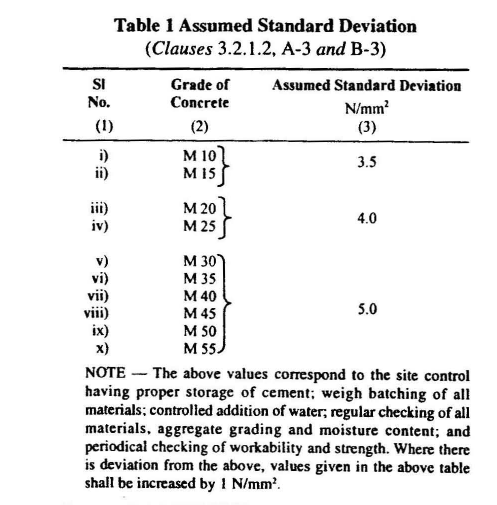
Determining Standard Deviation
IS 10262 provides guidance on determining standard deviation using historical compressive strength test results where sufficient production data is available.
If adequate test records are not available, the standard permits the use of assumed values based on the grade of concrete and expected quality control.
For new projects, engineers often begin with assumed values and later update them as more test data becomes available.
Practical Site Tip
Many construction projects overlook continuous monitoring of standard deviation.
Maintaining a record of cube test results throughout the project helps identify quality issues early and allows adjustments before defects become widespread.
Step 2: Selection of Water-Cement Ratio
The water-cement ratio (w/c ratio) is one of the most important parameters in concrete technology.
It represents the ratio of the mass of water to the mass of cement used in the concrete mix.
Even small changes in this ratio can significantly affect concrete performance.
Why is Water-Cement Ratio Important?
The water-cement ratio controls several key properties:
- Compressive strength
- Durability
- Permeability
- Shrinkage
- Crack resistance
- Resistance to chemical attack
Generally:
- Lower water-cement ratio → Higher strength and better durability.
- Higher water-cement ratio → Improved workability but lower strength and increased permeability.
The selected ratio should satisfy both the required strength and the durability requirements specified for the project’s exposure condition.
Factors Influencing Water-Cement Ratio
Engineers consider several factors while selecting an appropriate ratio:
- Required concrete grade
- Exposure condition
- Cement type
- Use of mineral admixtures
- Use of chemical admixtures
- Desired durability
- Laboratory trial mix results
A common mistake on construction sites is adding extra water to improve workability. While this may make placement easier, it can significantly reduce strength and durability. Instead, workability should be improved using approved admixtures or by optimizing the mix.
Step 3: Selection of Water Content
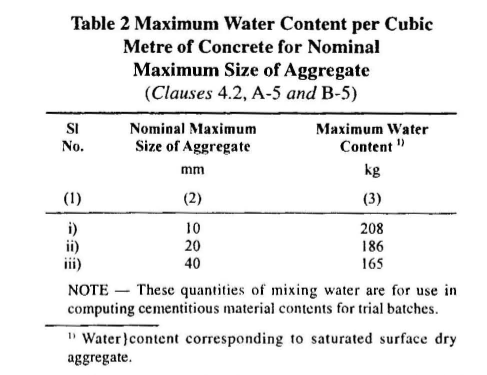
After deciding the water-cement ratio, the next step is estimating the amount of water required for one cubic meter of concrete.
Water content affects both fresh and hardened concrete.
Water Content Influences
- Slump
- Pump-ability
- Ease of compaction
- Bleeding
- Segregation
- Surface finish
- Strength (indirectly through the water-cement ratio)
IS 10262 provides guidance on estimating the initial water content based on factors such as the nominal maximum size of aggregate and the desired workability. This value is then adjusted, if necessary, after trial mixes.
Factors Affecting Water Requirement
- Aggregate size
- Aggregate shape
- Surface texture
- Slump requirement
- Pumping method
- Admixture type
- Temperature
- Moisture condition of aggregates
Practical Example
Rounded aggregates usually require less water because they offer lower internal friction.
Crushed angular aggregates generally require more water to achieve the same level of workability.
Similarly, larger aggregate sizes tend to reduce the water demand because of their lower total surface area.
Step 4: Calculation of Cementitious Material Content
Once the water content and water-cement ratio are selected, the required cementitious material content can be estimated.
Cementitious materials may include:
- Ordinary Portland Cement (OPC)
- Portland Pozzolana Cement (PPC)
- Portland Slag Cement (PSC)
- Fly Ash
- Ground Granulated Blast Furnace Slag (GOBS)
- Silica Fume (where applicable)
The quantity should satisfy:
- Strength requirements
- Durability requirements
- Workability requirements
IS 456 also specifies minimum cement content requirements for different environmental exposure conditions to ensure adequate durability.
Why Cement Content Matters
Too little cement may result in:
- Low strength
- Poor durability
- Increased permeability
- Honeycombing
Excessive cement may lead to:
- Higher heat of hydration
- Increased shrinkage
- Greater risk of thermal cracking
- Higher construction costs
The goal of mix design is to determine an optimum cementitious content rather than simply maximizing cement usage.
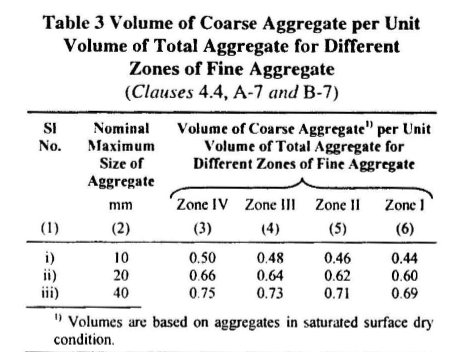
Step 5: Estimation of Coarse Aggregate Proportion
Aggregates occupy nearly 60–75% of the volume of concrete, making them one of the most important components of any mix.
Proper coarse aggregate proportioning improves:
- Strength
- Dimensional stability
- Economy
- Durability
- Workability
IS 10262 provides guidance on selecting the approximate coarse aggregate proportion based on the nominal maximum size of aggregate and the grading zone of fine aggregate. Adjustments may be required depending on workability, pumping requirements, and trial mix observations.
Factors Affecting Coarse Aggregate Proportion
- Maximum aggregate size
- Fine aggregate grading
- Pumped concrete
- Reinforcement congestion
- Workability requirement
- Aggregate shape
Practical Site Observation
Increasing coarse aggregate generally reduces cement demand and improves economy.
However, excessive coarse aggregate can reduce workability and make concrete difficult to compact, especially in heavily reinforced structural members.
Step 6: Combination of Different Aggregate Sizes
Many construction projects use a combination of different coarse aggregate sizes instead of relying on a single size.
For example:
- 10 mm aggregate
- 20 mm aggregate
Using multiple sizes helps achieve better particle packing.
Benefits of Combined Aggregate Gradation
- Reduced voids
- Lower cement requirement
- Improved workability
- Reduced segregation
- Better finish
- Improved pump-ability
Proper blending of aggregate sizes contributes to denser, more durable concrete.
Step 7: Estimation of Fine Aggregate Proportion
Fine aggregate fills the voids between coarse aggregate particles and contributes significantly to workability and cohesiveness.
The proportion of fine aggregate depends on:
- Aggregate grading
- Water content
- Pumping requirements
- Coarse aggregate proportion
- Desired workability
Effects of Excess Fine Aggregate
Too much sand may cause:
- Higher water demand
- Increased shrinkage
- Higher cement consumption
- Greater drying cracks
Effects of Insufficient Fine Aggregate
Too little sand may lead to:
- Segregation
- Harsh concrete
- Poor surface finish
- Difficulty in compaction
The objective is to achieve a balanced proportion that provides adequate cohesiveness without unnecessarily increasing the water demand.
Practical Example – Understanding Material Balance
Imagine preparing concrete like cooking a balanced meal.
- Cement acts as the binder.
- Water activates the cement.
- Fine aggregate fills small spaces.
- Coarse aggregate forms the structural skeleton.
- Admixtures improve performance.
If any ingredient is too high or too low, the overall quality suffers. Concrete mix design is therefore about finding the right balance rather than maximizing a single component.
Common Mistakes During Mix Design
Many quality issues arise because site personnel deviate from the approved mix.
Some common mistakes include:
- Adding water at the site without approval.
- Ignoring aggregate moisture corrections.
- Using different aggregate sources without testing.
- Incorrect batching by volume instead of weight.
- Changing admixture dosage without laboratory verification.
- Failing to re calibrate weighing equipment.
- Skipping trial mixes before production.
Good quality concrete depends not only on a well-designed mix but also on strict control during production and placement.
QA/QC Engineer’s Best Practices
To ensure consistent concrete quality:
- Verify material test certificates before use.
- Check aggregate moisture daily.
- Monitor batching plant calibration regularly.
- Record slump values for every truck.
- Maintain cube test records systematically.
- Review trends in compressive strength results.
- Avoid unauthorized addition of water at site.
- Ensure proper curing immediately after placement.
These practices help maintain consistency between the laboratory-designed mix and the concrete actually placed in the structure.
Step 8: Trial Mixes
A concrete mix designed on paper is only a starting point. The actual performance of concrete depends on the characteristics of locally available materials, batching accuracy, mixing efficiency, and environmental conditions. Therefore, trial mixes are essential before the mix is approved for production.
The purpose of a trial mix is to confirm that the proposed proportions can achieve the required strength, workability, and durability under practical conditions.
Objectives of Trial Mixes
A trial mix helps engineers to:
- Verify the required workability.
- Confirm the expected compressive strength.
- Check whether the mix is cohesive and free from segregation.
- Assess bleeding characteristics.
- Fine-tune the proportions before large-scale production.
- Evaluate the compatibility of cement and admixtures.
If the trial mix does not achieve the desired performance, the proportions are adjusted and tested again until satisfactory results are obtained.
What is Checked During a Trial Mix?
Engineers evaluate several fresh and hardened concrete properties, including:
Fresh Concrete
- Slump or workability.
- Ease of mixing.
- Ease of placement.
- Pump-ability (if applicable).
- Segregation.
- Bleeding.
- Surface finish.
Hardened Concrete
- Compressive strength.
- Density.
- Surface quality.
- Durability-related properties where required.
Only after satisfactory laboratory performance should the mix be used for actual construction.
Adjustments After Trial Mix
It is common for the first trial mix to require modifications. Engineers may adjust the mix based on observed performance.
Examples include:
If Workability is Low
Possible solutions:
- Optimize aggregate grading.
- Use an approved water-reducing admixture.
- Slightly adjust the aggregate proportions.
Adding extra water without technical approval should always be avoided because it changes the water-cement ratio and may reduce strength and durability.
If Concrete Segregates
Possible reasons include:
- Excess water.
- Poor aggregate grading.
- Insufficient fine aggregate.
- Inappropriate aggregate proportions.
Engineers typically review the aggregate balance and cohesiveness of the mix.
If Strength is Lower Than Expected
Possible causes:
- Incorrect batching.
- High water-cement ratio.
- Poor quality aggregates.
- Cement variation.
- Improper curing.
- Inadequate compaction.
The root cause should be identified before modifying the mix.
From Laboratory to Construction Site
A common mistake is assuming that a laboratory-approved mix will automatically perform the same on site.
In reality, site conditions differ significantly due to:
- Transportation delays.
- Weather changes.
- Aggregate moisture variations.
- Batching inaccuracies.
- Improper compaction.
- Poor curing.
For this reason, QA/QC engineers continuously monitor concrete quality throughout the project.
Quality Control During Concrete Production
Concrete quality depends on more than a well-designed mix. Consistent quality control is equally important.
Before Batching
Engineers should verify:
- Approved mix design.
- Material test reports.
- Cement storage conditions.
- Aggregate cleanliness.
- Moisture content of aggregates.
- Calibration of batching equipment.
- Availability of approved admixtures.
During Batching
Key quality checks include:
- Accurate weighing of materials.
- Correct water dosage.
- Proper admixture dosage.
- Uniform mixing time.
- Monitoring concrete temperature where required.
Automatic batching plants generally provide better consistency than manual batching.
During Transportation
Concrete should reach the placement location without significant loss of workability.
Engineers should monitor:
- Transit time.
- Drum rotation.
- Concrete temperature.
- Initial slump.
Long transportation times may require suitable admixtures rather than additional water.
During Placement
Quality checks include:
- Slump verification.
- Proper vibration.
- Avoiding cold joints.
- Layer-wise concreting.
- Adequate cover to reinforcement.
Poor placement practices can reduce concrete quality even when the mix itself is correct.
During Curing
Curing is often one of the most neglected stages of construction.
Proper curing helps:
- Improve hydration.
- Increase strength.
- Reduce shrinkage cracks.
- Enhance durability.
- Improve resistance to water penetration.
Even an excellent mix design cannot compensate for poor curing practices.
Practical Workflow of Concrete Mix Design
The overall process can be understood through the following workflow:
Step 1 – Identify the required concrete grade.
↓
Step 2 – Collect material properties and project requirements.
↓
Step 3 – Select an appropriate water-cement ratio considering both strength and durability.
↓
Step 4 – Estimate water content based on workability needs.
↓
Step 5 – Calculate cementitious material content.
↓
Step 6 – Estimate coarse and fine aggregate proportions.
↓
Step 7 – Prepare laboratory trial mixes.
↓
Step 8 – Test fresh and hardened concrete.
↓
Step 9 – Adjust proportions if necessary.
↓
Step 10 – Approve the mix for construction.
↓
Step 11 – Monitor quality continuously during production.
This systematic approach ensures that the concrete placed on site performs as intended throughout the structure’s service life.
Common Mistakes in Concrete Mix Design
Based on site experience, some of the most frequent mistakes include:
- Adding water to increase slump.
- Ignoring moisture corrections for aggregates.
- Using untested aggregate sources.
- Incorrect batching by volume.
- Excessive cement without technical justification.
- Poor compaction.
- Delayed placement.
- Inadequate curing.
- Lack of regular compressive strength testing.
- Failure to monitor production consistency.
Avoiding these mistakes improves both concrete quality and project economy.
Best Practices for Site Engineers
Whether you are a Site Engineer, QA/QC Engineer, or Project Engineer, the following practices can help maintain concrete quality:
- Use only approved materials.
- Follow the approved mix design without unauthorized changes.
- Check aggregate moisture content daily.
- Verify batching plant calibration periodically.
- Record slump values for every concrete delivery.
- Prepare and test compressive strength specimens as per project requirements.
- Investigate abnormal test results immediately.
- Ensure proper curing for all structural members.
- Maintain complete quality records for traceability.
These practices reduce variability and improve the reliability of concrete production.
Frequently Asked Questions (FAQs)
1. What is concrete mix design?
Concrete mix design is the process of determining the optimum proportions of cement, water, aggregates, and admixtures to produce concrete that meets the required strength, workability, durability, and economy.
2. Why is IS 10262:2019 important?
IS 10262:2019 provides guidelines for proportioning concrete mixes using locally available materials and laboratory trial mixes, helping engineers achieve consistent concrete quality.
3. What is the role of IS 456:2000 in mix design?
IS 456:2000 specifies durability requirements such as exposure conditions, limits on water-cement ratio, and minimum cement content. These requirements are considered while developing the concrete mix.
4. Why are trial mixes necessary?
Trial mixes verify that the proposed mix achieves the required workability and compressive strength before it is used for actual construction.
5. Can extra water be added at the construction site?
Adding water without technical approval is generally discouraged because it alters the water-cement ratio, which can reduce strength, increase permeability, and adversely affect durability.
6. What factors influence concrete strength?
Concrete strength depends on several factors, including the water-cement ratio, cement quality, aggregate properties, batching accuracy, compaction, curing, and overall quality control during production.
Conclusion
Concrete mix design is one of the most critical processes in concrete construction. A well-designed mix not only achieves the required compressive strength but also provides adequate workability, durability, and economy. Following the methodology outlined in IS 10262:2019 while considering the durability provisions of IS 456:2000 helps engineers produce reliable and consistent concrete for a wide range of construction projects.
However, preparing a mix design is only the beginning. The true performance of concrete depends on proper material selection, accurate batching, well-executed trial mixes, careful placement, effective compaction, and thorough curing. Continuous quality control throughout the project ensures that the concrete delivered to the structure matches the performance expected during the design stage.
By understanding the principles behind concrete mix design rather than simply following calculations, civil engineers can make informed decisions that improve structural safety, durability, and cost efficiency.
About QUALCONN
At QUALCONN, we simplify construction quality management through practical engineering resources, inspection checklists, technical guides, QA/QC templates, and industry-focused learning materials. Our goal is to help engineers, contractors, and construction professionals deliver projects with confidence, compliance, and quality.
Explore more engineering resources:
- Concrete Quality Checklists
- Reinforcement Inspection Guides
- Waterproofing Inspection Templates
- MEP QA/QC Checklists
- Civil Engineering Blogs and Tutorials
- Construction Quality Management Resources
Whether you’re a student preparing for your first site visit or an experienced engineer managing large infrastructure projects, QUALCONN provides practical tools to support every stage of construction.
Continue learning, build with confidence, and make quality your strongest foundation.