
What is M30 Concrete?
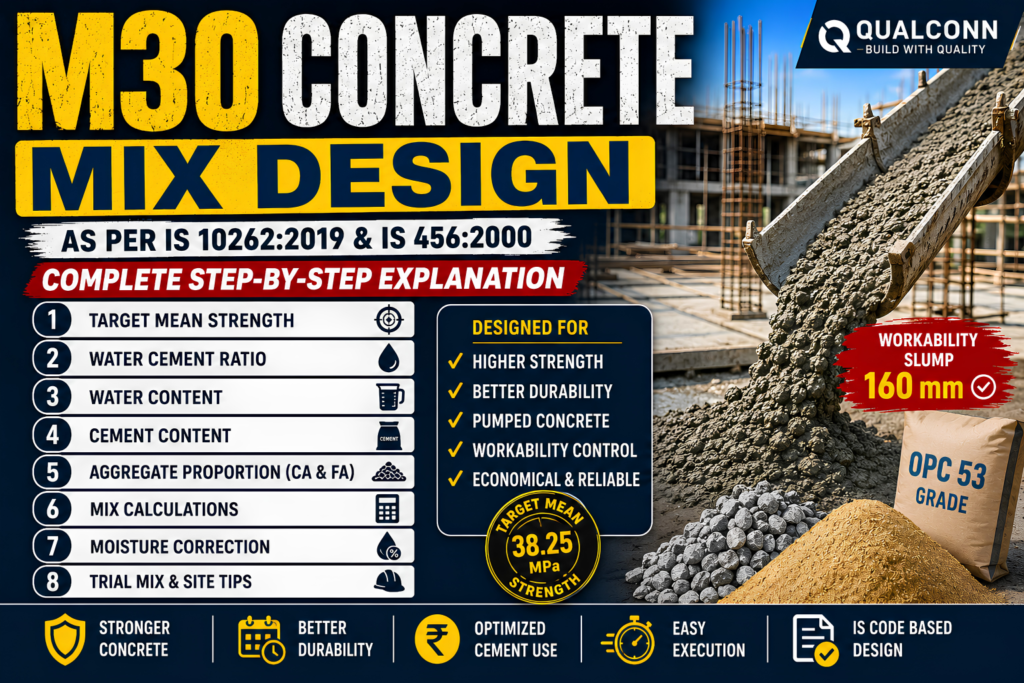
M30 concrete is a design mix concrete having a characteristic compressive strength (fck) of 30 MPa (30 N/mm²) after 28 days of curing. Here, “M” stands for Mix or Grade of Concrete, while “30” denotes the characteristic compressive strength. According to IS 456:2000, M30 belongs to the Standard Grade Concrete category and is widely used in RCC structures where higher strength and durability are required.
Applications of M30 Concrete
M30 concrete is commonly used in:
- Multi-storey residential buildings
- Commercial complexes
- RCC beams and slabs
- Columns and footings
- Water tanks
- Retaining walls
- Industrial floors
- Bridges and culverts
- Pumped concrete works
- Infrastructure projects
Why Mix Design is Required?
Concrete mix design ensures that concrete achieves:
- Required compressive strength
- Desired workability
- Required durability
- Economical cement consumption
- Uniform quality
- Better long-term performance
For M30 concrete, mix design is mandatory as per IS 10262:2019, and nominal mix proportions are not recommended.
Applicable IS Codes
| IS Code | Purpose |
|---|---|
| IS 10262:2019 | Concrete Mix Proportioning – Guidelines |
| IS 456:2000 | Plain and Reinforced Concrete – Code of Practice |
| IS 383:2016 | Specification for Coarse and Fine Aggregates |
| IS 2386 (Part 3):1963 | Testing of Aggregates |
| IS 4031 (Part 11):1988 | Determination of Specific Gravity of Cement |
| IS 9103 | Chemical Admixtures |
| IS 1199 | Sampling and Testing of Fresh Concrete |
Design Data
| Particular | Value |
|---|---|
| Grade | M30 |
| Characteristic Strength (fck) | 30 MPa |
| Maximum Aggregate Size | 20 mm |
| Cement | OPC 53 Grade |
| Exposure Condition | Moderate |
| Minimum Cement Content | 300 kg/m³ |
| Maximum Cement Content | 450 kg/m³ |
| Adopted Water-Cement Ratio | 0.45 |
| Slump | 160 mm |
| Method of Placing | Pumped Concrete |
| Fine Aggregate | Zone II |
| Coarse Aggregate | Crushed Angular |
| Standard Deviation | 5 MPa |
Material Test Data
| Property | Value |
|---|---|
| Specific Gravity of Cement | 3.16 |
| Specific Gravity of Fine Aggregate | 2.46 |
| Specific Gravity of Coarse Aggregate | 2.73 |
| Specific Gravity of Water | 1.00 |
| Admixture | Superplasticizer |
Step 1: Target Mean Strength
IS Code
IS 10262:2019 Clause 5.2
Formula
Target Mean Strength = fck + (1.65 × S)
Where:
- fck = Characteristic Strength = 30 MPa
- S = Standard Deviation = 5 MPa
Calculation
Target Mean Strength = 30 + (1.65 × 5)
= 38.25 MPa
Step 2: Selection of Water-Cement Ratio
According to IS 456:2000 Table 5, the maximum water-cement ratio for moderate exposure is 0.50. However, to achieve M30 strength, a water-cement ratio of 0.45 is adopted.
Adopted Water-Cement Ratio = 0.45
Step 3: Water Content
According to IS 10262:2019 Table 4, the recommended water content for 20 mm angular aggregate is 186 kg/m³ for a slump of 25–50 mm.
For a required slump of 160 mm, water is increased and then reduced by approximately 20% using a superplasticizer as per IS 9103.
Adopted Water Content = 168 kg/m³
Step 4: Cement Content
Formula
Cement Content = Water Content ÷ Water-Cement Ratio
Calculation:
= 168 ÷ 0.45
= 373 kg/m³
Check with IS 456:2000 Table 5:
- Minimum Cement = 300 kg/m³ ✔
- Maximum Cement = 450 kg/m³ ✔
Therefore, 373 kg/m³ is acceptable.
Step 5: Aggregate Proportion
According to IS 10262:2019 Table 5:
For:
- 20 mm Aggregate
- Zone II Sand
- Water-Cement Ratio = 0.45
Adopt:
| Aggregate | Volume Fraction |
|---|---|
| Coarse Aggregate | 0.63 |
| Fine Aggregate | 0.37 |
Step 6: Absolute Volume Method
As per IS 10262:2019, the quantities of cement, water, admixture, fine aggregate, and coarse aggregate are calculated using the Absolute Volume Method.
Formula
Volume = Mass ÷ (Specific Gravity × 1000)
The remaining volume after deducting cement, water, and admixture is divided between fine and coarse aggregates according to the selected volume fractions.
Moisture Correction
Before batching, adjust the water quantity based on the moisture content and water absorption of aggregates.
Typical values:
- Fine Aggregate Water Absorption = 1.0%
- Fine Aggregate Moisture = 2.0%
- Coarse Aggregate Water Absorption = 0.5%
- Coarse Aggregate Moisture = 0.5%
Moisture corrections help maintain the designed water-cement ratio and ensure consistent concrete quality.
Final Mix Proportion (Trial Mix)
| Material | Quantity |
|---|---|
| Cement | 373 kg |
| Water | 168 litres |
| Fine Aggregate | ≈670 kg |
| Coarse Aggregate | ≈1210 kg |
| Superplasticizer | 0.8–1.2% of Cement |
Approximate Mix Ratio (by Weight)
1 : 1.80 : 3.25
Water-Cement Ratio = 0.45
Note: The above quantities are an illustrative trial mix based on the given material properties. As required by IS 10262:2019, the final mix proportions should always be verified and adjusted through laboratory trial mixes before use in actual construction.
FAQs on M30 Concrete Mix Design (As per IS 10262:2019 & IS 456:2000)
1. What is M30 concrete?
M30 concrete is a design mix concrete having a characteristic compressive strength of 30 MPa (30 N/mm²) at 28 days. It is widely used in RCC structures requiring higher strength and durability than M25 concrete.
2. Why is M30 concrete called a design mix?
M30 concrete is called a design mix because the proportions of cement, fine aggregate, coarse aggregate, water, and admixtures are determined through laboratory calculations and trial mixes as per IS 10262:2019, rather than using fixed nominal proportions.
3. Which IS code is used for M30 concrete mix design?
The primary code is:
- IS 10262:2019 – Concrete Mix Proportioning – Guidelines
It is used together with:
- IS 456:2000
- IS 383:2016
- IS 2386 (Part 3)
- IS 4031 (Part 11)
- IS 9103
- IS 1199
4. What is the target mean strength of M30 concrete?
The target mean strength is calculated using the formula:
Target Mean Strength = fck + (1.65 × Standard Deviation)
For M30:
- Characteristic Strength = 30 MPa
- Standard Deviation = 5 MPa
Therefore,
Target Mean Strength = 38.25 MPa
5. Why is the target mean strength higher than 30 MPa?
Concrete production always has slight variations in materials and workmanship. Therefore, concrete is designed for a higher average strength to ensure that the required characteristic strength of 30 MPa is consistently achieved.
6. What is the maximum water-cement ratio for M30 concrete?
According to IS 456:2000 Table 5, the maximum water-cement ratio for Moderate Exposure is 0.50. However, for M30 concrete, an adopted water-cement ratio of 0.45 is commonly selected to achieve the required strength.
7. Why is a lower water-cement ratio used?
A lower water-cement ratio:
- Increases compressive strength
- Improves durability
- Reduces permeability
- Minimizes shrinkage and cracking
- Enhances long-term performance
8. What is the minimum cement content for M30 concrete?
For Moderate Exposure, the minimum cement content is:
300 kg/m³ (IS 456:2000 Table 5)
9. What is the maximum cement content allowed?
According to IS 456:2000 Clause 8.2.4.2, the maximum cement content should not exceed 450 kg/m³, unless special considerations justify a higher value.
10. Why is a superplasticizer used?
Superplasticizers improve the workability of concrete without increasing the water content. Their benefits include:
- Better pumpability
- Reduced water demand
- Higher strength
- Improved finish
- Reduced segregation and bleeding
They should comply with IS 9103.
11. What slump is suitable for pumped M30 concrete?
For pumped concrete, a slump of 100–180 mm is generally adopted depending on pumping distance, reinforcement congestion, and site conditions. In this design example, a 160 mm slump has been considered.
12. Why are trial mixes necessary?
The calculated mix proportions are only the starting point. IS 10262:2019 requires laboratory trial mixes to verify:
- Workability
- Density
- Compressive strength
- Pumpability
- Durability
The mix is adjusted until all performance requirements are satisfied.
13. What is the purpose of moisture correction?
Moisture correction accounts for the water already present in the aggregates or absorbed by them. This adjustment ensures that the effective water-cement ratio remains as designed, helping maintain consistent workability and strength.
14. Where is M30 concrete commonly used?
M30 concrete is commonly used for:
- RCC slabs
- Beams
- Columns
- Footings
- Retaining walls
- Water tanks
- Commercial buildings
- Industrial floors
- Bridges and infrastructure projects
15. What are the advantages of M30 concrete?
Some key advantages include:
- Higher strength than M25
- Better durability
- Improved resistance to environmental exposure
- Suitable for pumped concrete
- Economical for medium- to high-rise RCC structures
- Longer service life with proper curing
Practical Site Tips for M30 Concrete (QA/QC Engineer’s Guide)
These practical tips are based on common site practices and align with the intent of IS 10262:2019, IS 456:2000, and good quality control procedures.
1. Verify the Batching Plant Before Concreting
- Ensure the batching plant has been calibrated.
- Check cement, aggregate, and water weighing accuracy.
- Verify the mix ID matches the approved M30 mix design.
- Confirm that the correct admixture is being used.
Site Tip: Never allow manual adjustments to the mix without approval from the QA/QC engineer.
2. Check Aggregate Moisture Every Morning
Aggregate moisture changes due to rain and weather conditions.
Always verify:
- Moisture content of sand
- Surface moisture of coarse aggregate
Site Tip: If the sand is wet and moisture correction is not applied, the effective water-cement ratio will increase, reducing concrete strength.
3. Never Add Water at Site
One of the biggest reasons for low-strength concrete is adding water after the transit mixer reaches the site.
Instead:
- Use the approved dosage of superplasticizer.
- Obtain approval before any adjustments.
Site Tip: Even 10 litres of extra water in 1 m³ of concrete can significantly affect strength and durability.
4. Check Slump Before Pouring
Perform a slump test for every truck or at the frequency specified in the quality plan.
For pumped M30 concrete:
- Typical slump: 100–180 mm
- Project requirement: 160 mm
Site Tip: Reject concrete showing segregation, excessive bleeding, or slump outside the specified tolerance.
5. Monitor Transit Time
Concrete should ideally be placed within the project-specified time from batching.
Site Tip: If traffic delays are expected, inform the batching plant in advance. Never attempt to restore workability by adding water at site.
6. Inspect Reinforcement Before Concreting
Before pouring:
- Check reinforcement spacing.
- Verify clear cover blocks.
- Ensure bars are clean and free from loose rust, oil, or mud.
- Confirm all embedded items and sleeves are fixed.
Site Tip: Once concrete is poured, correcting reinforcement defects is difficult and costly.
7. Ensure Proper Formwork
Before concreting:
- Verify line, level, and dimensions.
- Check supports and bracing.
- Seal joints to prevent grout leakage.
- Apply shuttering oil evenly.
Site Tip: Poor formwork can cause honeycombing, dimensional errors, and surface defects.
8. Place Concrete Continuously
Concrete should be placed in layers without unnecessary delays.
Avoid:
- Free fall exceeding 1.5 m
- Segregation during placement
- Cold joints due to long interruptions
Site Tip: Keep a standby vibrator and backup power source ready.
9. Compact Concrete Properly
Use needle vibrators correctly:
- Insert vertically.
- Overlap vibration zones.
- Do not over-vibrate.
- Avoid touching reinforcement and formwork unnecessarily.
Site Tip: Over-vibration may cause segregation, while under-vibration can result in honeycombing.
10. Start Curing at the Right Time
Begin curing after the concrete has hardened sufficiently to avoid surface damage.
Recommended methods:
- Ponding
- Wet hessian
- Continuous water spraying
- Curing compounds (where approved)
Site Tip: In hot weather, delayed curing can lead to plastic shrinkage cracks.
11. Cast Test Cubes Correctly
Ensure:
- Cube moulds are clean and oiled.
- Concrete is compacted properly.
- Cubes are labelled with date, grade, and location.
- Cubes are cured under standard conditions.
Site Tip: Incorrect cube casting or curing can produce misleading strength results.
12. Maintain Concrete Records
Record the following for every pour:
- Date and time of batching
- Truck number
- Mix grade
- Slump value
- Cube identification
- Ambient temperature
- Quantity poured
- Pour location
Site Tip: Good documentation helps trace issues quickly if strength or quality problems arise.
Common Site Mistakes to Avoid
| Mistake | Possible Consequence |
|---|---|
| Adding water at site | Reduced strength and durability |
| Skipping slump test | Poor workability control |
| Inadequate vibration | Honeycombing and voids |
| Delayed curing | Surface cracking and lower strength |
| Incorrect moisture correction | Variation in water-cement ratio |
| Poor formwork | Leakage, misalignment, and surface defects |
| Improper cube casting | Unreliable compressive strength results |
| Using expired cement | Lower strength development |