
Introduction
In every construction project, successful execution is measured not only by the quality of work but also by effective financial management. One of the most important responsibilities of a Quantity Surveyor (QS) or Commercial Engineer is managing the billing process. Accurate billing ensures that contractors receive timely payments, subcontractors are compensated fairly, and the project maintains healthy cash flow throughout its lifecycle.
Whether you are a civil engineering student, a junior quantity surveyor, a billing engineer, or a commercial manager, understanding these processes is essential for building a successful career in construction commercial management.
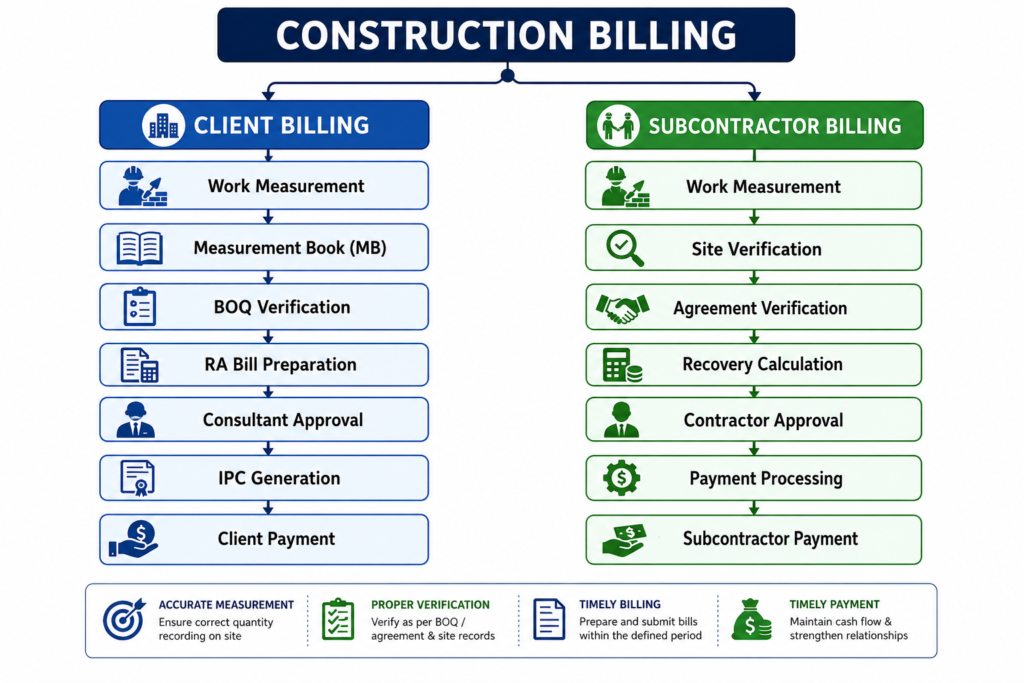
Understanding Construction Billing
Construction projects involve continuous execution of work over several months or years. Unlike retail businesses where payment is received immediately after delivery, construction companies receive payments periodically based on work completed.
Billing serves several purposes:
- Maintains project cash flow
- Records completed work
- Tracks project progress
- Controls project costs
- Reduces payment disputes
- Ensures contractual compliance
- Supports project profitability
Without an organized billing process, even profitable projects may face severe cash flow issues.
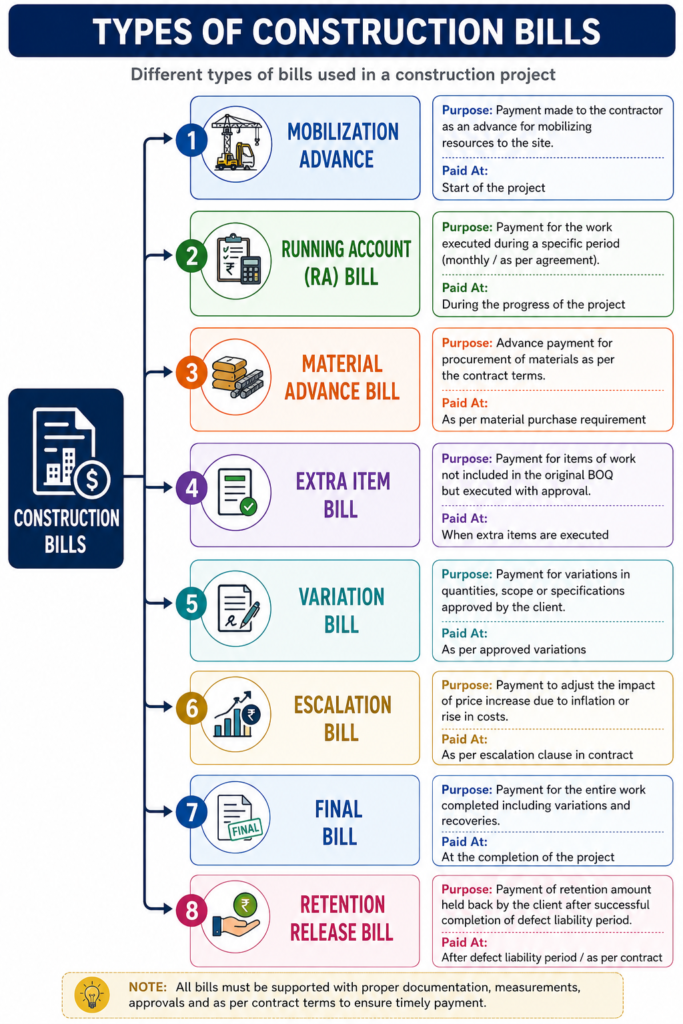
What is Client Billing?
Client Billing is the process through which the main contractor submits a payment application to the project owner (client) for work completed during a specified billing period.
The billing amount is determined using:
- Executed quantities
- Approved Bill of Quantities (BOQ)
- Contract rates
- Approved variation orders
- Previous payments
- Retention deductions
- Applicable taxes
After submission, the consultant verifies the claim, certifies the quantities, and recommends payment to the client.
Once approved, payment is released according to the contract terms.
Objectives of Client Billing
The primary objectives include:
- Recover project costs
- Generate project revenue
- Maintain positive cash flow
- Record construction progress
- Monitor contract value
- Support project financial reporting
Proper client billing ensures that contractors have sufficient funds to continue construction activities without interruption.
Client Billing Workflow
A standard client billing process consists of the following stages:
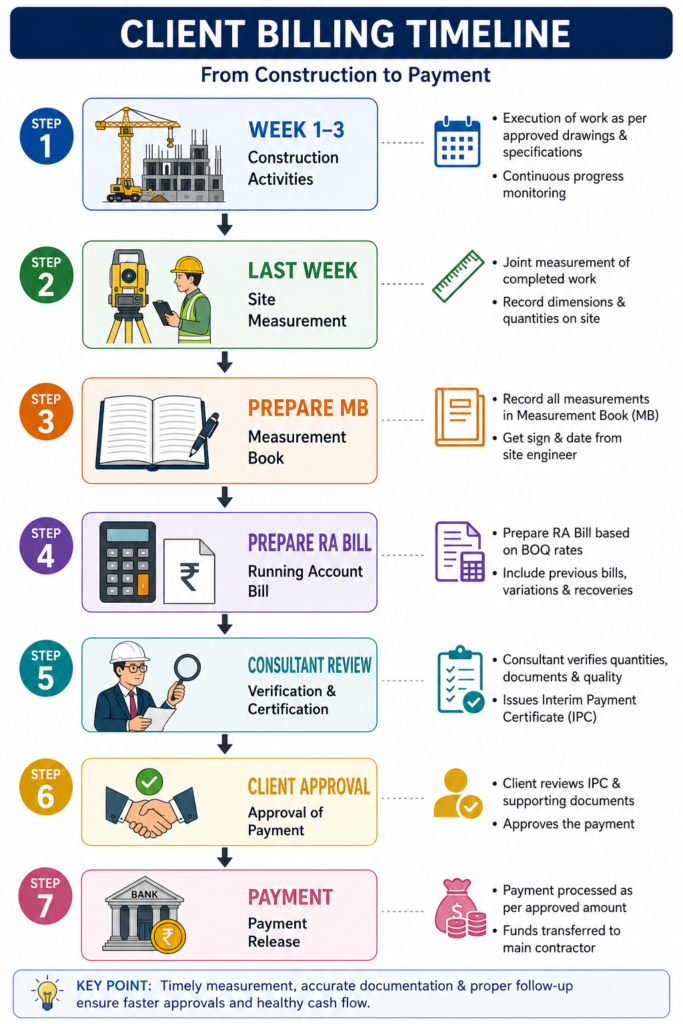
1. Site Work Execution
Construction activities are completed according to approved drawings and project specifications.
Examples include:
- Earthwork
- Reinforcement
- Concrete works
- Masonry
- Plastering
- Flooring
- Finishing works
Only completed and measurable work qualifies for billing.
2. Quantity Measurement
The Quantity Surveyor measures completed work using approved drawings and actual site dimensions.
Measurements may include:
- Cubic meters of concrete
- Square meters of plaster
- Kilograms of reinforcement
- Running meters of piping
- Number of fixtures installed
Accuracy during measurement is critical because billing depends entirely on measured quantities.
3. Measurement Book (MB) Preparation
The Measurement Book is one of the most important documents in construction billing.
It records:
- Item description
- Location
- Dimensions
- Quantity calculations
- Date of measurement
- Engineer’s signature
The MB serves as legal evidence supporting every payment claim.
4. BOQ Verification
Measured quantities are compared with the approved Bill of Quantities.
The Quantity Surveyor verifies:
- BOQ item number
- Unit of measurement
- Contract rate
- Approved quantities
- Previous billed quantities
- Balance quantities
Any discrepancy must be resolved before billing.
5. RA Bill Preparation
A Running Account (RA) Bill summarizes all measured work completed during the billing cycle.
An RA Bill generally contains:
- Previous certified quantity
- Current quantity
- Total quantity
- BOQ rate
- Gross amount
- Retention
- Recovery
- Taxes
- Net payable amount
This becomes the official payment claim submitted to the client.
6. Supporting Documentation
No payment application is complete without supporting documents.
Common attachments include:
- Measurement Book
- BOQ
- Quantity Abstract
- Approved Drawings
- Cube Test Reports
- Inspection Reports
- Site Photographs
- Material Approval Records
- Consultant Approvals
- Previous RA Bill Summary
- GST Invoice
These documents help consultants verify work and approve payments quickly.
7. Consultant Verification
The consultant reviews every item carefully.
Verification includes:
- Physical inspection
- Quantity checking
- Quality confirmation
- Drawing verification
- Contract compliance
- Previous payment reconciliation
Any discrepancy results in deductions or corrections before certification.
8. Payment Certification
Once verified, the consultant issues an Interim Payment Certificate (IPC) recommending payment to the client.
The IPC specifies:
- Certified work value
- Deductions
- Retention
- Recoveries
- Taxes
- Net certified amount
9. Payment Release
The client processes payment according to contractual payment terms, usually within 15–45 days after certification.
Timely payments enable contractors to continue project execution without financial stress.
What is Subcontractor Billing?
Most large construction projects involve specialized subcontractors for activities such as electrical work, plumbing, HVAC, waterproofing, aluminum works, false ceiling installation, painting, and landscaping.
Subcontractor Billing is the process through which these subcontractors submit payment claims to the main contractor for completed work.
Unlike client billing, subcontractor billing represents project expenditure rather than revenue.
Objectives of Subcontractor Billing
Subcontractor billing helps:
- Verify completed work
- Control project costs
- Monitor subcontract agreements
- Process timely payments
- Avoid duplicate billing
- Manage recoveries
- Maintain contractor-subcontractor relationships
Subcontractor Billing Process
The process generally includes:
Work Completion
The subcontractor completes work according to drawings and specifications.
Quantity Measurement
The Quantity Surveyor jointly measures completed work.
Agreement Verification
Measurements are compared with subcontract agreement rates.
Recovery Calculation
Material recoveries, advances, penalties, and retention amounts are deducted.
Bill Preparation
A subcontractor RA Bill is prepared.
Approval
Project managers and commercial teams verify the bill.
Payment
Finance releases payment after approval.
Key Documents Used in Subcontractor Billing
- Subcontract Agreement
- Approved BOQ
- Measurement Book
- Running Bill
- Material Reconciliation Statement
- Site Measurement Sheets
- Recovery Statement
- GST Invoice
- Work Completion Certificate
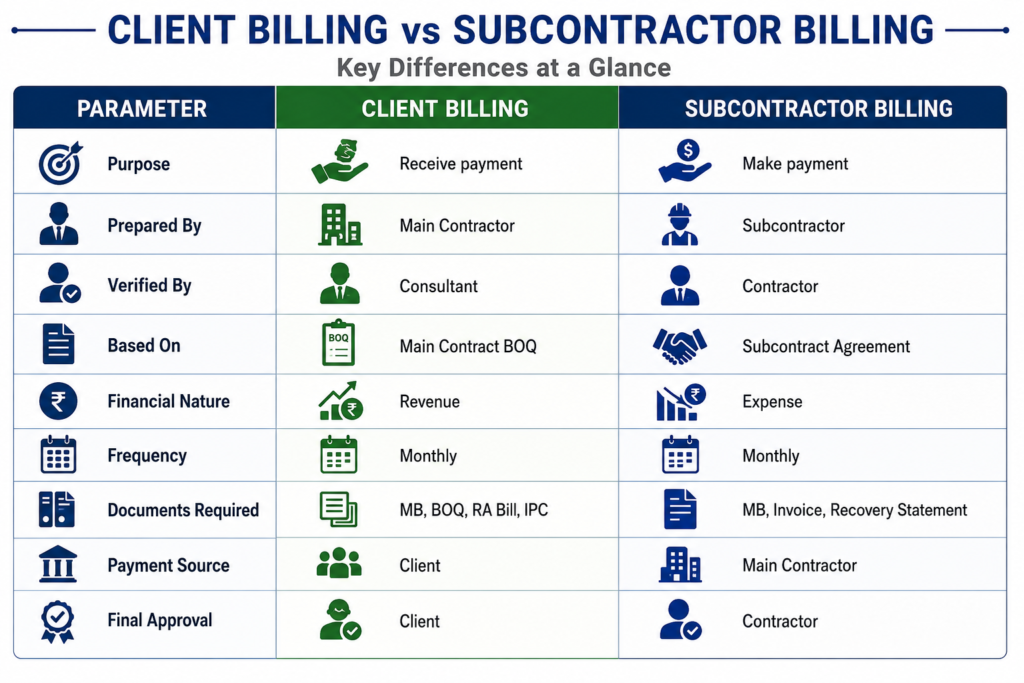
Client Billing vs. Subcontractor Billing
| Client Billing | Subcontractor Billing |
|---|---|
| Contractor bills the project owner | Subcontractor bills the contractor |
| Generates project income | Represents project expenditure |
| Based on main BOQ | Based on subcontract agreement |
| Certified by consultant | Certified by contractor |
| Payment received from client | Payment released to subcontractor |
| Supports company cash inflow | Supports project execution costs |
Understanding this distinction is essential for every commercial engineer.
Common Billing Terminology
Bill of Quantities (BOQ)
A detailed schedule listing every construction item, quantity, unit, and contract rate.
Measurement Book (MB)
The official record of all measured work carried out at the construction site.
Running Account Bill (RA Bill)
A periodic payment claim prepared during project execution.
Interim Payment Certificate (IPC)
A consultant-issued certificate recommending payment to the client.
Retention Money
A percentage of every payment withheld by the client until project completion to ensure quality and defect rectification.
Variation Order
Additional or omitted work approved after signing the contract.
Final Bill
The last payment application prepared after project completion, including all approved variations and recoveries.
Common Challenges in Construction Billing
Many construction companies experience delayed payments due to avoidable errors.
Common problems include:
- Incorrect quantity measurements
- Missing documentation
- Mathematical errors
- Duplicate quantities
- Unapproved variation claims
- Incorrect BOQ references
- Delayed site measurements
- Poor coordination between departments
- Incomplete invoices
- Lack of consultant approvals
Implementing standardized billing procedures minimizes these risks.
Best Practices for Quantity Surveyors
Professional Quantity Surveyors follow several best practices to improve billing accuracy:
- Measure work regularly instead of waiting until month-end.
- Maintain an updated Measurement Book.
- Verify drawings before measurement.
- Track approved variation orders separately.
- Reconcile quantities with previous bills.
- Maintain digital records of supporting documents.
- Coordinate with site engineers and planning teams.
- Cross-check calculations before submission.
- Submit bills within contractual deadlines.
- Keep communication transparent with consultants and clients.
Following these practices improves payment cycles and reduces disputes.
The Role of Technology in Construction Billing
Modern construction companies increasingly use digital tools to streamline billing processes.
Popular software solutions include:
- Microsoft Excel
- Primavera P6
- AutoCAD Quantity Takeoff
- CostX
- Candy CCS
- PlanSwift
- Revit Quantity Takeoff
- ERP systems such as SAP and Oracle
These tools reduce manual calculations, improve accuracy, and provide real-time commercial reporting.
Why Accurate Billing Matters
Accurate billing directly impacts project success.
Benefits include:
- Better cash flow management
- Improved profitability
- Reduced payment disputes
- Transparent financial records
- Strong client relationships
- Better subcontractor management
- Improved commercial decision-making
- Faster project completion
Poor billing practices, on the other hand, can lead to delayed payments, legal disputes, cost overruns, and reduced profit margins.
Career Opportunities in Billing and Commercial Management
Professionals skilled in construction billing are in high demand across the industry.
Career roles include:
- Billing Engineer
- Quantity Surveyor
- Commercial Engineer
- Cost Engineer
- Contracts Engineer
- Planning and Billing Engineer
- Senior Quantity Surveyor
- Commercial Manager
- Project Controls Engineer
- Contracts Manager
Developing expertise in billing, cost control, and commercial management significantly enhances career growth.
Conclusion
As the construction industry embraces digital transformation, professionals who combine traditional QS skills with modern billing software and commercial management techniques will be better equipped to lead successful projects. Whether you are just beginning your career or looking to enhance your expertise, understanding construction billing is a fundamental step toward becoming a competent and trusted commercial professional.
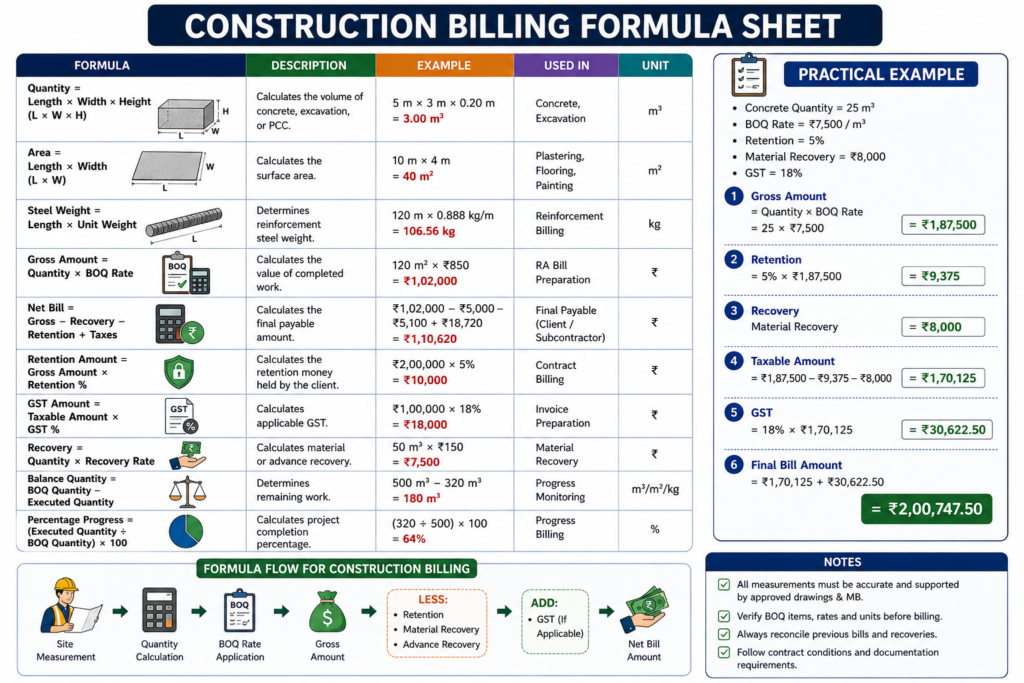
Frequently Asked Questions (FAQs)
1. What is the difference between Client Billing and Subcontractor Billing?
Client Billing is the payment claim submitted by the main contractor to the project owner, while Subcontractor Billing is the payment claim submitted by subcontractors to the main contractor.
2. What is an RA Bill?
A Running Account Bill (RA Bill) is a periodic payment application prepared based on the quantity of work completed during a specific billing period.
3. What documents are required for construction billing?
Key documents include the BOQ, Measurement Book (MB), RA Bill, approved drawings, quantity abstracts, inspection reports, GST invoice, variation orders, and material reconciliation statements.
4. Why is the Measurement Book (MB) important?
The Measurement Book is the official record of site measurements and serves as the primary evidence supporting every payment claim.
5. How can billing disputes be minimized?
Billing disputes can be reduced through accurate quantity measurements, proper documentation, timely approvals, regular reconciliation, and adherence to contract conditions.

Pingback: How to Learn Primavera P6 from Scratch: The Ultimate Beginner’s Guide (2026) - qualconn