
Introduction
The construction industry has historically been slower than many sectors in adopting new technologies. For decades, quality management relied heavily on manual inspections, paper-based checklists, engineer experience, and reactive problem-solving. While these traditional methods remain valuable, the growing complexity of modern construction projects has created a need for smarter, faster, and more reliable quality control systems.
Artificial Intelligence (AI) is now emerging as one of the most trans formative technologies in construction. From automated defect detection and predictive analytics to drone inspections and digital twins, AI is changing how engineers, contractors, consultants, and project owners manage quality throughout a project’s lifecycle.
As global construction spending continues to rise, quality failures remain a major challenge. Defects, rework, delays, safety incidents, and compliance issues can significantly increase project costs and damage reputations. AI provides a powerful solution by enabling proactive quality management rather than simply reacting to problems after they occur.
In this comprehensive guide, we will explore how AI is transforming construction quality management, the technologies driving this change, practical applications on construction sites, benefits, challenges, and what the future holds for the industry.
Understanding Construction Quality Management
Before examining AI’s role, it’s important to understand what construction quality management involves.
Construction quality management is the process of ensuring that materials, workmanship, systems, and completed structures meet project specifications, design requirements, regulatory standards, and client expectations.
The primary objectives include:
- Preventing defects
- Reducing rework
- Ensuring compliance
- Maintaining safety standards
- Improving project performance
- Delivering durable structures
Traditional quality management typically includes:
Quality Planning
Defining standards, procedures, and acceptance criteria.
Quality Assurance (QA)
Establishing systems and processes that prevent quality failures.
Quality Control (QC)
Inspecting and testing work to identify defects.
Corrective Actions
Addressing issues discovered during inspections.
Although effective, traditional methods often depend on human observation, manual documentation, and delayed reporting. This is where AI introduces significant improvements.
What Is Artificial Intelligence in Construction?
Artificial Intelligence refers to computer systems capable of performing tasks that normally require human intelligence.
These tasks include:
- Learning from data
- Recognizing patterns
- Making predictions
- Understanding images
- Processing documents
- Supporting decision-making
In construction, AI systems analyze large volumes of information generated from:
- Site photographs
- Videos
- Drone surveys
- BIM models
- Inspection reports
- Quality records
- Sensor networks
- Project schedules
- Equipment monitoring systems
The AI then identifies trends, predicts risks, detects defects, and recommends actions.
Instead of replacing engineers, AI acts as an intelligent assistant that improves accuracy and efficiency.
Why the Construction Industry Needs AI
Construction projects generate enormous amounts of data every day.
Consider a typical high-rise building project:
- Thousands of inspection records
- Hundreds of drawings
- Multiple revisions
- Daily progress reports
- Safety observations
- Material test reports
- Site photographs
Managing this information manually becomes increasingly difficult.
At the same time, the industry continues to face major challenges:
Rising Rework Costs
Rework is one of the largest hidden costs in construction.
Common causes include:
- Poor workmanship
- Design discrepancies
- Incorrect installations
- Communication failures
- Inadequate inspections
Even small defects can result in expensive repairs later.
Labor Shortages
Many countries are experiencing shortages of skilled construction professionals.
This increases pressure on existing teams and makes consistent quality control more challenging.
Complex Projects
Modern projects involve:
- Advanced building systems
- Sustainability requirements
- Smart technologies
- Multiple stakeholders
Maintaining quality across these complexities requires better tools.
Tight Deadlines
Owners expect faster project delivery while maintaining high standards.
AI helps balance speed and quality.
The Evolution from Reactive to Predictive Quality Management
Traditionally, quality management has been reactive.
The typical process looks like this:
- Work is completed.
- Inspection occurs.
- Defect is discovered.
- Rework is performed.
- Project cost increases.
AI changes this model.
Instead of waiting for failures, AI predicts where problems are likely to occur.
The new process becomes:
- AI analyzes project data.
- Potential risks are identified.
- Preventive measures are implemented.
- Quality issues are avoided.
This shift from reactive to predictive management represents one of AI’s greatest advantages.
Key AI Technologies Transforming Construction Quality
Several AI technologies are driving innovation across construction projects.
Machine Learning
Machine learning is a branch of AI that enables systems to improve automatically through experience.
By analyzing historical project data, machine learning models can:
- Predict defects
- Forecast delays
- Identify quality risks
- Improve inspection planning
The more data available, the smarter the system becomes.
Example
If previous projects show waterproofing failures occurring under certain weather conditions, machine learning algorithms can identify similar risk patterns in current projects.
Computer Vision
Computer vision allows AI systems to interpret and understand images and videos.
This technology has become one of the most valuable tools in construction quality management.
Computer vision systems can detect:
- Concrete cracks
- Surface defects
- Missing reinforcement
- Improper installations
- Safety violations
The system continuously analyzes visual information and flags potential concerns.
Practical Example
A site engineer uploads photographs of completed masonry work.
The AI system automatically identifies:
- Alignment issues
- Missing mortar joints
- Cracks
- Dimensional deviations
This significantly reduces inspection time.
Natural Language Processing (NLP)
Construction projects generate extensive documentation.
Natural Language Processing allows AI to understand written information.
NLP can analyze:
- Inspection reports
- Specifications
- Method statements
- NCR reports
- Quality records
Benefits include:
- Faster document reviews
- Automated report generation
- Improved information retrieval
Engineers can quickly locate critical information without manually reviewing hundreds of documents.
Predictive Analytics
Predictive analytics uses historical data and statistical models to forecast future outcomes.
In quality management, predictive analytics can estimate:
- Probability of defects
- Inspection requirements
- High-risk activities
- Equipment failures
This allows teams to focus resources where they are most needed.
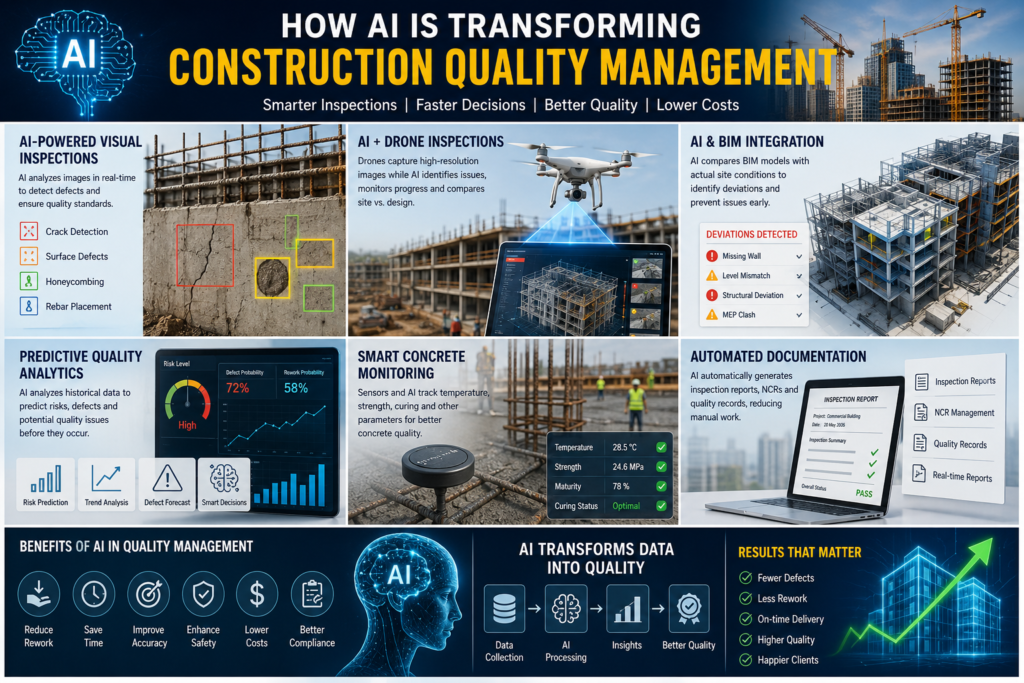
AI-Powered Visual Inspections
Visual inspection remains one of the most important quality control activities in construction.
Traditionally, inspectors walk through sites and manually identify defects.
This process can be:
- Time-consuming
- Inconsistent
- Dependent on individual experience
AI-powered visual inspection systems significantly improve efficiency.
How It Works
The process typically involves:
Step 1: Image Collection
Images are captured using:
- Smartphones
- Tablets
- Site cameras
- Drones
Step 2: AI Analysis
Computer vision algorithms analyze images and compare them against predefined standards.
Step 3: Defect Identification
Potential issues are automatically highlighted.
Step 4: Reporting
Inspection reports are generated instantly.
Types of Defects AI Can Detect
Concrete Defects
AI systems can identify:
- Cracks
- Honeycombing
- Surface voids
- Segregation
- Spalling
Finishing Defects
Detection capabilities include:
- Uneven surfaces
- Paint defects
- Tile alignment issues
- Poor workmanship
Structural Components
AI can verify:
- Reinforcement placement
- Steel connections
- Structural alignment
- Installation accuracy
Benefits of AI Visual Inspections
Faster Assessments
Thousands of images can be reviewed in minutes.
Improved Accuracy
AI does not suffer from fatigue or distractions.
Better Documentation
Every inspection is digitally recorded.
Consistency
Inspection standards remain uniform across projects.
Drone Technology and AI in Quality Management
Drones have become increasingly common on construction sites.
When combined with AI, they create powerful inspection systems capable of covering large areas quickly and safely.
Why Drones Are Valuable
Traditional inspections often require:
- Scaffolding
- Ladders
- Elevated work platforms
- Extensive manpower
Drones eliminate many of these requirements.
They provide access to:
- Roofs
- Facades
- Bridges
- Towers
- Large infrastructure projects
without exposing workers to unnecessary risks.
AI-Enhanced Drone Inspections
Modern drone systems capture:
- High-resolution images
- Video footage
- Thermal data
- 3D mapping information
AI analyzes this information to identify:
- Cracks
- Corrosion
- Water intrusion
- Structural damage
- Construction deviations
Example
A drone surveys a completed building facade.
The AI automatically detects:
- Missing sealants
- Surface cracks
- Misaligned panels
- Water penetration risks
Inspection reports are generated within hours instead of days.
Benefits of Drone-Based Quality Inspections
- Faster site coverage
- Improved worker safety
- Reduced inspection costs
- Better documentation
- Enhanced project visibility
- Higher inspection frequency
AI and BIM Integration: A Game-Changer for Quality Management
One of the most significant advancements in construction technology is the integration of Artificial Intelligence with Building Information Modeling (BIM).
BIM has already transformed how buildings are designed, coordinated, and constructed. However, when AI is layered on top of BIM, the model evolves from a static digital representation into an intelligent decision-making system.
What Is AI-Powered BIM?
AI-powered BIM combines:
- 3D building models
- Project schedules
- Material specifications
- Inspection records
- Site progress data
- Historical quality information
The AI continuously compares actual site conditions against the BIM model and identifies discrepancies.
How It Improves Quality
AI can automatically detect:
- Missing building components
- Incorrect installations
- Design deviations
- Dimensional inaccuracies
- Construction sequencing issues
For example, if a wall is constructed differently from the approved BIM model, AI software can immediately flag the discrepancy for review.
Benefits for Engineers
- Faster inspections
- Reduced manual verification
- Improved coordination
- Better compliance management
- Early issue detection
Instead of discovering errors weeks later, project teams can identify and correct problems in real time.
Digital Twins: The Future of Construction Quality
A Digital Twin is a virtual replica of a physical building or infrastructure asset.
Unlike traditional BIM models, Digital Twins continuously receive live data from the actual project.
Components of a Digital Twin
Digital Twins combine:
- BIM models
- IoT sensors
- AI analytics
- Drone surveys
- Monitoring systems
- Equipment data
The result is a living digital representation of the project.
How Digital Twins Support Quality Management
Imagine a large commercial building under construction.
Sensors installed throughout the project monitor:
- Temperature
- Humidity
- Concrete curing
- Structural movement
- Equipment performance
AI continuously analyzes this information.
If abnormal conditions occur, the system immediately alerts engineers.
Example
During concrete curing, sensors indicate unexpected temperature variations.
The Digital Twin identifies a potential quality risk and recommends corrective action before strength development is affected.
This level of proactive quality control was nearly impossible with traditional methods.
Smart Concrete Monitoring with AI
Concrete quality remains one of the most critical factors in construction.
Traditional concrete testing relies on:
- Cube tests
- Cylinder tests
- Laboratory analysis
- Manual inspections
While effective, these methods provide only periodic snapshots of performance.
AI-powered monitoring systems provide continuous insight.
How Smart Concrete Monitoring Works
Embedded sensors collect real-time data such as:
- Internal temperature
- Moisture levels
- Strength development
- Curing conditions
AI algorithms analyze this data and predict:
- Concrete maturity
- Strength gain
- Potential cracking risks
- Optimal curing duration
Advantages of AI-Based Concrete Monitoring
Improved Quality Control
Engineers receive real-time updates rather than waiting for laboratory reports.
Reduced Risk of Cracking
AI identifies temperature differentials that may lead to thermal cracking.
Faster Construction Decisions
Project teams can determine exactly when concrete reaches required strength levels.
Better Documentation
All quality records are stored digitally and automatically.
AI-Powered Quality Checklists
Traditional paper checklists often create challenges:
- Missing information
- Illegible handwriting
- Lost records
- Inconsistent inspections
AI-powered digital checklists address these issues.
Features of Smart Checklists
Modern systems can:
Guide Inspectors
The software walks inspectors through required inspection steps.
Validate Entries
AI identifies missing or unusual responses.
Recommend Actions
If an issue is detected, the system suggests corrective measures.
Generate Reports Automatically
Inspection reports are produced instantly.
Practical Example
An engineer performs a reinforcement inspection.
The checklist verifies:
- Bar spacing
- Lap lengths
- Cover blocks
- Anchorage details
If measurements fall outside acceptable limits, the AI immediately generates a non-conformance notification.
This improves consistency and reduces oversight.
Automated Construction Documentation
Documentation is essential for quality management, but it consumes a significant amount of engineering time.
Construction projects generate:
- Inspection reports
- Test reports
- Method statements
- Quality records
- NCRs
- Daily reports
AI can automate much of this workload.
AI-Generated Reports
Modern AI systems can create:
Inspection Summaries
Automatically generated from field observations.
Quality Dashboards
Real-time visual reports showing project quality performance.
NCR Documentation
AI drafts reports based on identified issues.
Progress Reports
Generated using site photos and project data.
Benefits
Time Savings
Engineers spend less time on paperwork.
Improved Accuracy
Reduced risk of manual data entry errors.
Better Traceability
All information is stored digitally and easily searchable.
Faster Decision-Making
Project managers receive up-to-date information instantly.
Predictive Defect Detection
Perhaps the most exciting application of AI is predictive defect detection.
Instead of identifying defects after construction, AI predicts where defects are likely to occur.
How Predictive Detection Works
AI analyzes:
- Historical project data
- Inspection records
- Weather conditions
- Material information
- Workforce performance
- Construction methods
The system identifies patterns associated with previous quality failures.
Example: Waterproofing Defects
Suppose historical data reveals:
- Waterproofing failures increase during monsoon seasons.
- Certain installation methods have higher failure rates.
- Specific material combinations show recurring problems.
The AI recognizes these trends and alerts project teams before work begins.
Preventive inspections can then be scheduled.
Benefits
Reduced Rework
Problems are prevented rather than corrected.
Lower Costs
Early intervention is significantly cheaper.
Improved Quality Outcomes
Teams focus on high-risk activities.
Better Resource Allocation
Inspection resources are directed where they matter most.
AI for Non-Conformance Management
Non-Conformance Reports (NCRs) are essential for tracking quality issues.
However, managing NCRs manually can be inefficient.
AI improves the process by:
- Categorizing NCRs automatically
- Identifying recurring issues
- Suggesting corrective actions
- Tracking closure status
- Predicting future non-conformance
Root Cause Analysis Using AI
One of the biggest challenges in quality management is identifying root causes.
AI can analyze thousands of historical records to determine:
- Why defects occur
- Which subcontractors generate the most NCRs
- Which activities have the highest risk
- Which materials contribute to failures
This helps organizations eliminate recurring problems.
Real-World Applications of AI in Construction Quality
AI is no longer a future concept.
Leading construction companies worldwide are already implementing AI-powered solutions.
Infrastructure Projects
AI is being used to monitor:
- Bridges
- Highways
- Rail networks
- Airports
Applications include:
- Crack detection
- Structural monitoring
- Progress verification
- Asset management
Commercial Buildings
Large commercial developments use AI for:
- Quality inspections
- BIM validation
- Defect tracking
- Documentation management
Residential Construction
Home builders increasingly use AI to:
- Improve workmanship quality
- Standardize inspections
- Reduce warranty claims
- Monitor subcontractor performance
AI Tools Used in Construction Quality Management
Several leading platforms are helping construction companies adopt AI.
Autodesk Construction Cloud
Features:
- AI-powered risk analysis
- Document management
- BIM integration
- Quality tracking
OpenSpace
Uses AI and computer vision for:
- Site documentation
- Progress tracking
- Quality verification
Buildots
Provides:
- Automated progress monitoring
- AI-powered quality analysis
- BIM comparison
DroneDeploy
Offers:
- Drone inspections
- Site mapping
- Defect identification
- Reporting automation
Procore AI
Supports:
- Construction documentation
- Quality workflows
- Project analytics
The Financial Impact of AI on Construction Quality
Organizations adopting AI often experience measurable benefits.
Potential improvements include:
Reduced Rework
Early defect detection reduces costly repairs.
Improved Productivity
Engineers spend less time on repetitive tasks.
Faster Inspections
AI processes large amounts of data rapidly.
Better Compliance
Automated tracking improves adherence to standards.
Enhanced Client Satisfaction
Higher-quality projects lead to stronger reputations and repeat business.
Challenges of Implementing AI
Despite its advantages, AI adoption presents several challenges.
Initial Investment
Software, hardware, and training can require significant upfront costs.
Data Quality
AI systems depend on accurate information.
Poor-quality data produces unreliable results.
Workforce Training
Employees must learn how to use AI tools effectively.
Integration Issues
Older systems may not integrate easily with new AI platforms.
Resistance to Change
Some organizations remain hesitant to move away from traditional methods.
However, as AI technologies mature, these barriers are gradually decreasing.
Frequently Asked Questions (FAQs) – AI in Construction Quality Management
1. What is AI in construction quality management?
Artificial Intelligence (AI) in construction quality management uses machine learning, computer vision, predictive analytics, and automation to improve inspections, detect defects, analyze project data, and enhance overall construction quality.
2. How does AI improve construction quality?
AI improves construction quality by identifying defects early, automating inspections, predicting risks, monitoring workmanship, reducing human error, and providing real-time insights for corrective actions.
3. Can AI replace quality engineers?
No. AI is designed to support quality engineers, not replace them. Engineers still provide professional judgment, decision-making, and technical expertise while AI handles repetitive and data-intensive tasks.
4. What are the main benefits of AI in construction?
The key benefits include:
- Reduced rework
- Faster inspections
- Improved documentation
- Better compliance tracking
- Enhanced productivity
- Lower project costs
- Increased quality consistency
5. How is AI used in construction inspections?
AI analyzes photos, videos, drone imagery, and sensor data to detect cracks, surface defects, alignment issues, missing components, and other quality concerns automatically.
6. What is computer vision in construction?
Computer vision is an AI technology that enables software to analyze and interpret images and videos. In construction, it is used to identify defects, verify installations, and monitor project progress.
7. How do drones and AI work together in construction?
Drones capture site images and videos, while AI analyzes the data to detect defects, monitor progress, compare site conditions with BIM models, and generate inspection reports.
8. What is predictive quality management?
Predictive quality management uses AI and historical project data to forecast potential quality issues before they occur, allowing teams to take preventive action.
9. How does AI reduce construction rework?
AI identifies potential defects and risks early in the construction process, helping project teams correct issues before they become costly rework.
10. What role does BIM play in AI-powered quality management?
AI integrated with BIM can compare actual site conditions with design models, identify deviations, verify installations, and improve quality control throughout the project lifecycle.
11. What is a Digital Twin in construction?
A Digital Twin is a virtual representation of a physical asset that receives real-time data from sensors, equipment, and monitoring systems. It helps track performance and identify quality issues proactively.
12. How can AI help with concrete quality control?
AI can monitor concrete temperature, curing conditions, moisture levels, and strength development using embedded sensors, ensuring better quality and durability.
13. What types of defects can AI detect?
AI can detect:
- Concrete cracks
- Honeycombing
- Surface voids
- Tile alignment issues
- Waterproofing defects
- Structural deviations
- Finishing defects
14. Is AI expensive for construction companies?
The initial investment can be significant, but AI often reduces costs through lower rework, improved productivity, better resource utilization, and enhanced project efficiency.
15. Can small construction companies use AI?
Yes. Many AI-powered construction tools are now available through cloud-based subscriptions, making them accessible to small and medium-sized contractors.
16. How does AI improve construction documentation?
AI can automatically generate inspection reports, organize quality records, summarize observations, and track project documentation, reducing administrative workload.
17. What are the challenges of implementing AI in construction?
Common challenges include:
- Initial investment costs
- Data quality issues
- Employee training requirements
- Integration with existing systems
- Resistance to technological change
18. Which AI tools are commonly used in construction?
Popular AI-powered construction platforms include:
- Autodesk Construction Cloud
- OpenSpace
- Buildots
- DroneDeploy
- Procore
- Revizto
19. What is the future of AI in construction quality management?
Future developments may include:
- Autonomous inspection robots
- Real-time defect detection
- AI-powered digital twins
- Automated compliance verification
- Predictive quality dashboards
- Fully integrated smart construction ecosystems
20. Why should construction companies adopt AI now?
Companies that adopt AI gain a competitive advantage through improved quality, reduced rework, enhanced efficiency, better decision-making, and stronger client satisfaction.
Will AI become standard in construction quality management?
Yes. As technology becomes more affordable and construction projects become increasingly data-driven, AI is expected to become a standard component of quality management systems worldwide.
How does AI help site engineers?
AI helps site engineers by automating inspections, tracking quality records, detecting defects, generating reports, and providing real-time insights for better decision-making.
Can AI improve construction safety and quality together?
Yes. AI can simultaneously monitor safety compliance and quality standards using cameras, sensors, drones, and predictive analytics, creating safer and higher-quality construction sites.
What industries are benefiting from AI-driven construction quality management?
AI is being adopted across residential, commercial, industrial, infrastructure, healthcare, transportation, and data center construction projects
Pingback: A Complete Guide for Quantity Surveyors(2026) - qualconn
Yes For More Details Kindly Mail Your queries