Introduction
Moreover, doors and windows are among the most critical finishing components in any construction project. They influence not only the building’s appearance but also its functionality, durability, safety, ventilation, sound insulation, and waterproofing performance. Poorly installed doors and windows often lead to issues such as leakage, operational difficulty, cracks, misalignment, air infiltration, and expensive maintenance problems after project handover.
Additionally, for civil engineers, QA/QC engineers, architects, site supervisors, and project managers, understanding proper installation and inspection procedures is essential to ensure construction quality and long-term building performance.
Typically, modern buildings commonly use two major systems:
- Wooden doors
- uPVC doors and windows
Each system requires specific quality checks during material inspection, installation, alignment, fixing, sealing, and finishing stages.
First, in this comprehensive guide, we will explore the essential door and window installation checks engineers must know.
Importance of Door & Window Quality Inspection
Proper inspection during installation helps:
- Prevent water leakage
- Improve thermal and sound insulation
- Ensure smooth operation
- Increase durability
- Reduce future maintenance costs
- Improve aesthetic appearance
- Ensure occupant safety
- Maintain project quality standards
Additionally, a small alignment issue can lead to long-term operational problems and customer complaints.
Types of Doors & Windows Used in Construction
Common Door Types
- Wooden flush doors
- Panel doors
- Veneer doors
- Fire-rated doors
- uPVC doors
- Aluminum doors
Common Window Types
- Sliding windows
- Casement windows
- Fixed windows
- Top-hung windows
- Combination windows
Additionally, wooden doors and uPVC windows are widely used in residential and commercial projects.
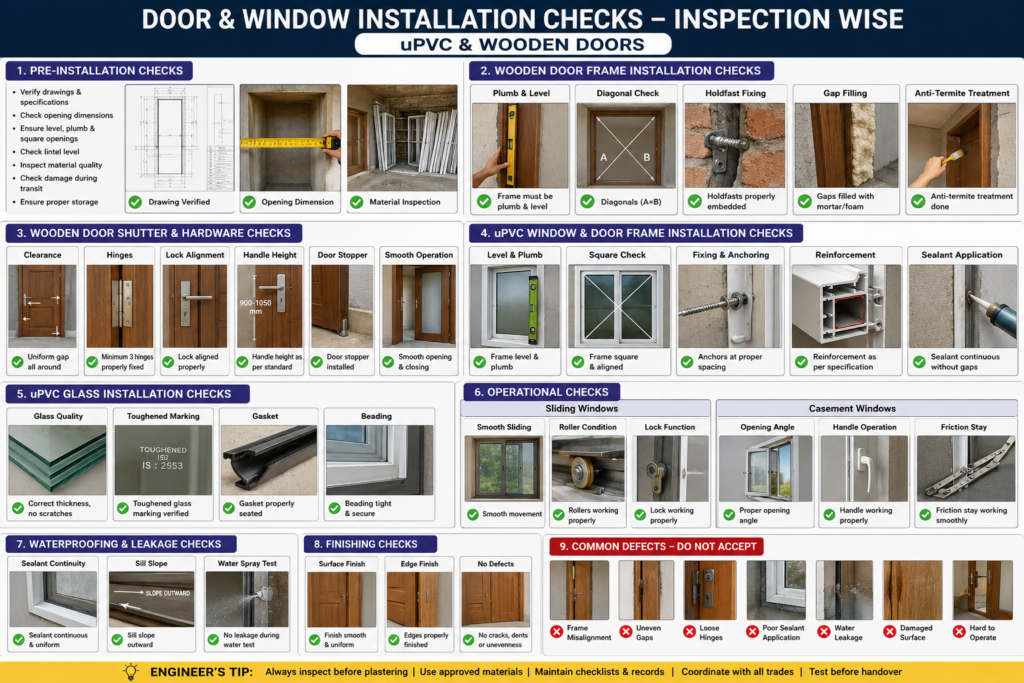
Pre-Installation Checks for Engineers
Before installation starts, engineers must verify several important aspects.
1. Drawing Verification
Check approved:
- Architectural drawings
- Shop drawings
- Door-window schedules
- Opening dimensions
- Elevation details
Therefore, verify that on-site dimensions align with the approved drawings.
Furthermore, the second step addresses Material Inspection. Material Inspection
Wooden Doors
Inspect for:
- Warping
- Cracks
- Moisture damage
- Surface defects
- Proper thickness
- Approved wood species
uPVC Frames
Verify:
- Brand approval
- Section thickness
- Reinforcement presence
- Surface finish
- Corner joint quality
3. Opening Inspection
Before frame installation:
- Ensure wall openings are level
- Verify verticality and plumb
- Check lintel level
- Confirm dimensions are correct
- Remove loose mortar and debris
However, improper openings directly affect alignment and finishing quality.
Wooden Door Installation Checks
1. Wooden Frame Installation Checks
Door frame installation is one of the most important quality control stages.
A. Alignment Checks
The frame should be:
- Perfectly vertical (plumb)
- Horizontally level
- Properly aligned with wall finish
Use:
- Spirit level
- Plumb bob
- Laser level
Improper alignment causes shutter rubbing and locking issues.
B. Diagonal Measurement Checks
Measure diagonals of the frame.
Both diagonal dimensions should be equal to ensure squareness.
Unequal diagonals indicate frame distortion.
C. Hold fast & Anchor Fixing
Inspect:
- Number of hold fasts
- Proper embedment depth
- Tight fixing with masonry
- Anchor bolt quality
Loose fixing may cause frame movement after usage.
D. Gap Filling
Gaps between frame and wall should be filled using:
- Cement mortar
- PU foam
- Approved filler material
Ensure:
- No hollow spaces
- No cracks
- Proper compaction
E. Anti-Termite Treatment
Wooden frames must receive:
- Anti-termite coating
- Preservative treatment
Furthermore, this improves durability and protects against insect damage.
Wooden Door Shutter Installation Checks
1. Clearance Inspection
Maintain uniform clearance between:
- Frame and shutter
- Bottom gap from flooring
Typical issues:
- Uneven gaps
- Floor rubbing
- Tight closing
2. Hinge Installation Checks
Verify:
- Minimum 3 hinges for standard doors
- Proper screw fixing
- Alignment of hinges
- Smooth movement
Loose hinges create operational problems over time.
3. Lock & Hardware Inspection
Inspect:
- Lock alignment
- Handle fixing
- Door closer installation
- Tower bolts
- Door stopper positioning
Hardware should function smoothly without obstruction.
4. Surface Finish Inspection
Check:
- Paint quality
- Polish uniformity
- Edge finishing
- Surface smoothness
Common defects:
- Bubbles
- Uneven coating
- Scratches
- Color variation
uPVC Door & Window Installation Checks
uPVC systems are widely preferred due to:
- Low maintenance
- Waterproofing performance
- Durability
- Thermal insulation
- Modern appearance
However, improper installation can still lead to major issues.
uPVC Frame Installation Checks
1. Level & Plumb Verification
Check frame alignment using:
- Spirit level
- Laser level
Ensure:
- Vertical plumb
- Horizontal level
- Proper corner alignment
Misalignment affects operation and waterproofing.
2. Frame Fixing Inspection
Inspect:
- Fastener spacing
- Anchor quality
- Reinforcement support
- Screw tightness
Improper fixing may cause frame bending or loosening.
3. Reinforcement Checks
Steel reinforcement inside uPVC profiles is essential for strength.
Verify:
- Reinforcement thickness
- Proper placement
- Manufacturer specifications
Lack of reinforcement reduces structural stability.
Glass Installation Checks
Glass installation requires careful inspection.
1. Glass Quality Verification
Check:
- Correct thickness
- Toughened glass markings
- Scratch-free surface
- No cracks or chips
2. Gasket & Beading Checks
Inspect:
- Rubber gasket continuity
- Tight beading installation
- Proper seating of glass
Loose beading can cause vibration and leakage.
3. Safety Compliance
Use toughened glass in:
- Balcony doors
- Large openings
- Staircase areas
- Low-level glazing
This improves occupant safety.
Operational Checks for uPVC Windows
Sliding Window Checks
Inspect:
- Roller movement
- Smooth sliding
- Track cleanliness
- Locking operation
Common issues:
- Jamming
- Noise
- Misalignment
Casement Window Checks
Verify:
- Proper opening angle
- Handle operation
- Friction stay movement
- Tight locking
Poorly aligned casement windows may not close properly.
Waterproofing & Leakage Inspection
Water leakage is one of the most common complaints after project handover.
1. Sealant Inspection
Inspect silicone sealant for:
- Continuity
- Proper adhesion
- Uniform application
- Gap-free sealing
Avoid:
- Air bubbles
- Cracks
- Incomplete sealing
2. Water Spray Test
Conduct water spray testing externally.
Check:
- Leakage at joints
- Sill seepage
- Frame-wall junctions
Testing helps identify hidden defects before handover.
3. Sill Slope Inspection
Window sills should have outward slope to drain rainwater properly.
Improper sill slope causes:
- Water stagnation
- Leakage
- Dampness
Finishing Quality Checks
Final appearance matters greatly in modern projects.
Check For:
- Scratches
- Dents
- Surface stains
- Sealant marks
- Paint damage
- Alignment with wall finish
Good finishing improves client satisfaction.
Common Defects Found on Site
Wooden Door Defects
- Warped shutters
- Loose hinges
- Improper polishing
- Uneven gaps
- Lock misalignment
- Cracked frames
uPVC Window Defects
- Water leakage
- Improper sealant
- Loose rollers
- Difficult sliding
- Glass rattling
- Corner joint failure
QA/QC Checklist for Engineers
Wooden Door Checklist
Frame Inspection
✔ Frame plumb checked
✔ Level verified
✔ Hold fast fixing proper
✔ Anti-termite treatment completed
Shutter Inspection
✔ Smooth operation
✔ Uniform clearance
✔ Hinges fixed correctly
✔ Lock alignment proper
Finish Inspection
✔ Paint/polish completed
✔ There must be no scratches or dents.
✔ Surface finish uniform
uPVC Door & Window Checklist
Frame Installation
✔ Proper alignment
✔ Fasteners fixed correctly
✔ Reinforcement verified
Glass Installation
✔ Glass thickness approved
✔ Toughened marking checked
✔ Gasket properly fixed
Waterproofing
✔ Silicone sealant completed
✔ Water spray test passed
Operation
✔ Smooth sliding/opening
✔ Lock functioning properly
✔ No noise or obstruction
Safety Considerations During Installation
Engineers should ensure:
- Proper PPE usage
- Safe handling of glass panels
- Working platform stability
- Proper lifting methods
- Edge protection during glazing
Glass handling accidents are common on construction sites.
Best Practices for Engineers
1. Conduct Mock-Up Approval
For premium projects, create sample installations before mass execution.
2. Coordinate With Multiple Teams
Door-window installation affects:
- Waterproofing teams
- Finishing teams
- Facade contractors
- Flooring contractors
Coordination reduces rework.
3. Maintain Inspection Records
Document:
- Checklists
- Photographs
- NCRs
- Testing reports
Proper documentation supports quality assurance.
4. Use Approved Materials Only
Never allow:
- Unapproved hardware
- Local sealants
- Inferior glass quality
Material quality directly impacts performance.
Role of QA/QC Engineers in Door & Window Inspection
QA/QC engineers are responsible for:
- Material approval
- Inspection monitoring
- Testing verification
- Defect identification
- Compliance documentation
- Final quality clearance
Their role is critical in preventing post-handover complaints.
Conclusion
Doors and windows are essential components that significantly impact a building’s functionality, aesthetics, comfort, and durability. Proper installation and quality inspection of wooden doors and uPVC windows are crucial for ensuring smooth operation, waterproofing performance, and long-term reliability.
Engineers must pay close attention to alignment, fixing quality, hardware installation, sealant application, and finishing standards during every stage of installation. Early identification of defects helps reduce future maintenance costs and improves overall project quality.
A well-installed door or window is not just about appearance — it represents the quality standards of the entire construction project.
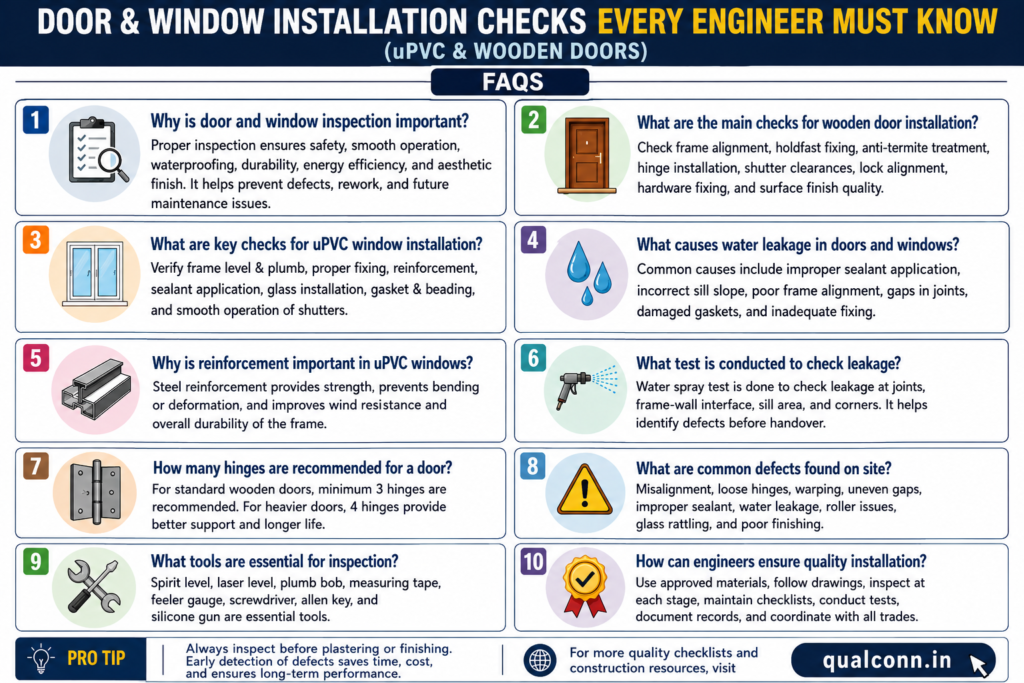
FAQs
1. Why is door and window inspection important in construction?
Door and window inspection helps prevent leakage, operational issues, misalignment, poor finishing, and future maintenance problems.
2. What are the main checks for wooden door installation?
Important checks include:
- Frame alignment
- Hold fast fixing
- Anti-termite treatment
- Hinge installation
- Lock alignment
- Surface finish quality
3. What causes water leakage in uPVC windows?
Common causes include:
- Improper sealant application
- Poor frame alignment
- Inadequate sill slope
- Loose gaskets
- Improper installation
4. Why is reinforcement important in uPVC windows?
Steel reinforcement provides structural strength and prevents bending or deformation of uPVC profiles.
5. What test is conducted to check window leakage?
A water spray test is commonly conducted to identify leakage around window frames and joints.
6. How many hinges are recommended for a standard wooden door?
Typically, a standard wooden door requires a minimum of 3 hinges for proper load distribution and smooth operation.
7. What are common defects in wooden doors?
Common defects include:
- Warping
- Uneven gaps
- Loose hinges
- Cracks
- Improper polishing
8. Why is silicone sealant important in uPVC installation?
Silicone sealant prevents water and air leakage between the frame and wall junction.
9. What tools are used for door and window inspection?
Common tools include:
- Spirit level
- Laser level
- Measuring tape
- Plumb bob
- Feeler gauge
10. How can engineers improve installation quality?
Engineers can improve quality by:
- Conducting regular inspections
- Using approved materials
- Maintaining QA/QC checklists
- Coordinating with installation teams
- Performing testing before handover