
The construction industry is entering a new era — one where schedules are no longer static spreadsheets and project management is no longer reactive. In 2026, Artificial Intelligence (AI), predictive analytics, and intelligent automation are reshaping how projects are planned, monitored, and delivered.
From AI-powered scheduling assistants to predictive QA analytics and real-time field intelligence, construction companies are moving toward smarter, faster, and more efficient project execution.
This shift is being called Construction Intelligence 2.0 — a transformation where construction systems learn, adapt, and optimize themselves continuously.
In this article, we’ll explore the latest AI construction technologies, the top platforms leading innovation, real-world use cases, implementation strategies, and how contractors can benefit from intelligent scheduling and predictive project management.
What Is Construction Intelligence 2.0?
Construction Intelligence 2.0 refers to the integration of:
- Artificial Intelligence (AI)
- Machine Learning (ML)
- Predictive Analytics
- Real-Time Field Data
- Smart Scheduling Systems
- Automated QA/QC Monitoring
- Reality Capture Technologies
Unlike traditional project management tools, modern AI platforms actively analyze construction data, identify risks, simulate outcomes, and recommend solutions before delays or cost overruns occur.
The goal is simple:
✅ Reduce delays
✅ Improve quality
✅ Optimize labor and resources
✅ Increase profitability
✅ Minimize rework
✅ Improve project visibility
Why AI Scheduling Is Becoming Essential in Construction
Construction scheduling has traditionally relied on CPM (Critical Path Method) schedules that often become outdated once field conditions change.
AI scheduling tools are changing this approach by:
- Continuously analyzing schedule risks
- Predicting delays before they happen
- Running instant “what-if” simulations
- Optimizing resources automatically
- Identifying hidden schedule bottlenecks
- Syncing field progress with planning teams
In 2026, intelligent scheduling is no longer a luxury — it is becoming a competitive advantage.
The Growing Adoption of AI in Construction
The construction industry has historically been slower in digital adoption compared to manufacturing or IT sectors. However, rising project complexity, labor shortages, and increasing client expectations are rapidly accelerating AI adoption.
Why Contractors Are Investing in AI
1. Rising Construction Costs
Material price fluctuations and labor costs are forcing contractors to optimize every aspect of project delivery.
2. Schedule Pressure
Clients increasingly demand faster completion timelines and better reporting transparency.
3. Skilled Labor Shortages
AI systems help reduce dependency on manual planning and repetitive administrative work.
4. Reduced Rework
Quality-related rework remains one of the biggest cost drains in construction projects.
5. Better Decision-Making
Executives now expect real-time dashboards instead of delayed weekly reports.
As a result, AI-powered construction software is becoming a major focus area for contractors worldwide.
1. ALICE Technologies – AI-Driven Targeted Optimization
One of the biggest innovations in construction AI comes from ALICE Technologies with its new Targeted Optimization feature.
This system helps contractors identify which construction activities can accelerate project schedules the most — even when full resource data is unavailable.
Key Features
- AI-powered schedule acceleration
- Near-critical path analysis
- Generative construction scheduling
- Resource optimization
- Predictive schedule intelligence
ALICE’s technology focuses heavily on identifying near-critical path drivers — activities that are not officially on the critical path but can still heavily impact project completion.
Early users reported recovering significant lost time using the platform.
Real-World Example
A contractor dealing with major schedule slippage used ALICE to identify hidden sequencing inefficiencies in structural and MEP activities. By reordering overlapping tasks and optimizing crew deployment, the project team recovered weeks of lost time without increasing labor costs.
Why It Matters
Traditional schedules often miss hidden delay risks. ALICE uses AI to uncover those hidden dependencies and optimize them automatically.
This means:
- Faster project delivery
- Reduced delay claims
- Better labor utilization
- Improved project forecasting

2. Planera’s “Manny” – AI Scheduling Assistant
Planera introduced Manny, an AI scheduling assistant designed to turn CPM schedules into live decision-making systems.
Instead of manually analyzing scheduling logic, project teams can now ask questions in plain English.
Examples of What Manny Can Do
- “What happens if concrete work slips by 5 days?”
- “Which activities are causing float reduction?”
- “How will rain delays impact handover?”
- “What tasks are affecting milestone completion?”
The AI instantly simulates downstream impacts and provides actionable insights.
Major Benefits
Faster Decision Making
Executives and site teams no longer need deep Primavera expertise to understand schedules.
Improved Collaboration
Field teams can interact with schedules naturally without relying entirely on planners.
Reduced Analysis Time
What once took hours of schedule analysis can now happen in minutes.
This represents a major shift toward democratizing construction planning intelligence.

3. Outbuild – Smarter Construction Scheduling Through Field Intelligence
Outbuild launched its Project Intelligence Platform, combining:
- Construction scheduling
- Field updates
- Mobile reporting
- Executive dashboards
- AI-driven schedule analysis
The platform integrates real-time site data directly into scheduling workflows.
What Makes Outbuild Different?
Real-Time Field Synchronization
Progress updates from mobile apps automatically reflect in schedules.
AI-Powered Schedule Intelligence
The system identifies risks and schedule impacts as site conditions change.
Schedule Impact Requests
Field issues become structured scheduling intelligence rather than disconnected reports.
This helps contractors maintain alignment between:
- Planning teams
- Site engineers
- Project managers
- Executives
The result is a schedule that continuously improves and adapts over time.

4. Procore Modernizes Cost Management
Procore upgraded its Project-Level Direct Cost Tool in 2026 with improved transparency and usability.
Improvements Include
- Better sorting and filtering
- Cleaner financial workflows
- Improved UI for accountants
- Faster project-level cost tracking
- Enhanced reporting visibility
While not purely AI-focused, these upgrades reflect the growing demand for integrated digital project controls.
Modern contractors now expect:
- Real-time financial tracking
- Connected project intelligence
- Faster reporting systems
- Integrated scheduling and cost analytics
5. Hand off – AI Project Management for Contractors
Hand off AI
Hand off launched an end-to-end AI Project Management Suite designed for small and mid-sized contractors.
The platform includes:
- AI Scheduling
- AI Daily Logs
- AI Client Portals
- Automated project workflows
- Real-time progress tracking
Key Advantage
The software can automatically generate schedules directly from estimates.
This reduces manual administrative work and creates a seamless workflow from bidding to project closeout.
Why Smaller Contractors Like It
Many mid-sized contractors struggle with disconnected systems and limited admin staff.
Hand off simplifies operations by centralizing:
- Scheduling
- Documentation
- Client communication
- Progress tracking
- Reporting
into a single AI-powered workflow.

Comparison of Top AI Construction Platforms in 2026
| Platform | Primary Focus | Key Strength |
|---|---|---|
| ALICE Technologies | Generative Scheduling | Schedule optimization |
| Planera | AI Scheduling Assistant | Natural language schedule analysis |
| Outbuild | Field + Scheduling Intelligence | Real-time site integration |
| Procore | Financial & Project Controls | Cost visibility |
| Handoff | Contractor Workflow Automation | End-to-end AI management |
This comparison highlights how different platforms are targeting different pain points within construction operations.
Emerging QA/QC Trends in Construction for 2026
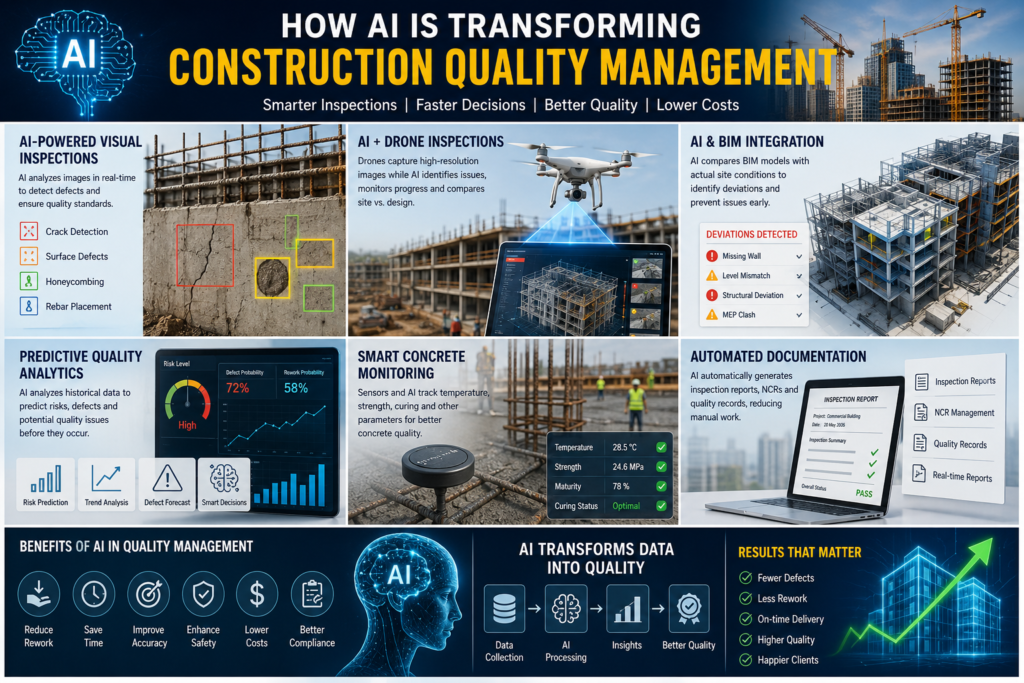
AI is not only transforming scheduling — it is also revolutionizing quality assurance and quality control.
1. Automated QA Dashboards
Smart sensors and field applications are now feeding QA dashboards automatically.
Benefits include:
- Faster defect reporting
- Reduced paperwork
- Real-time quality monitoring
- Faster corrective action tracking
2. Reality Capture + AI
Construction firms are increasingly using:
- 360° cameras
- Laser scanners
- Drone mapping
- AI image analysis
for construction verification and defect detection.
These systems compare actual site conditions with BIM models and planned work.
This helps identify:
- Installation errors
- Safety risks
- Progress deviations
- Quality defects
before they become expensive rework issues.
3. Predictive QA Analytics
AI platforms are now analyzing quality data to predict future project risks.
Companies like:
- ALICE Technologies
- Buildots
- Disperse
are exploring predictive systems that forecast:
- Schedule slips
- Rework probability
- Delay risks
- Productivity drops
based on quality deviations and field performance trends.
This is a major step toward proactive project management.
ESG and QA/QC Integration Is Growing Fast
In 2026, sustainability reporting is becoming tightly connected with construction quality systems.
Many contractors are now integrating:
- ESG compliance
- Carbon tracking
- Material verification
- Waste monitoring
- Quality assurance
into unified project intelligence platforms.
This allows companies to meet increasing regulatory and client reporting requirements while improving project transparency.
How Construction Companies Can Implement AI Successfully
Many contractors want to adopt AI but struggle with implementation. Here are practical steps for a successful transition.
Step 1: Start With Scheduling
Scheduling offers one of the fastest returns on investment.
Begin with:
- Delay prediction tools
- Resource optimization
- AI schedule analysis
Step 2: Digitize Field Reporting
AI systems require reliable project data.
Use:
- Mobile inspection apps
- Digital daily logs
- Cloud-based reporting systems
Step 3: Integrate BIM and QA Systems
Combining BIM with AI-driven QA systems improves:
- Clash detection
- Quality tracking
- Progress verification
Step 4: Train Teams Properly
Technology adoption succeeds only when teams understand the benefits.
Provide training for:
- Site engineers
- Planning engineers
- QA/QC teams
- Project managers
Step 5: Scale Gradually
Avoid trying to automate everything at once.
Start small, test workflows, and scale successful systems project by project.
Benefits of AI in Construction Project Management
Here’s why AI adoption is accelerating rapidly across the construction industry:
| Benefit | Impact |
|---|---|
| Faster Scheduling | Reduced project delays |
| Predictive Analytics | Early risk identification |
| Automated Reporting | Lower admin workload |
| Real-Time Intelligence | Better decision making |
| AI QA/QC Monitoring | Reduced rework |
| Smart Resource Planning | Higher productivity |
| Reality Capture | Improved verification |
| Integrated Cost Tracking | Better financial control |
Challenges Construction Companies Still Face
Despite the rapid innovation, challenges remain:
Resistance to Technology Adoption
Many field teams still rely on traditional workflows.
Data Quality Problems
AI systems require clean, accurate project data.
Training Requirements
Teams need education to fully leverage intelligent platforms.
Integration Complexity
Connecting BIM, ERP, scheduling, and QA systems remains difficult.
However, the long-term benefits are pushing more firms toward digital transformation.
Future of AI in Construction: What to Expect by 2030
The next decade could completely redefine construction operations.
Expected Trends
Autonomous Scheduling
AI systems may generate and continuously optimize schedules automatically.
Digital Twin Integration
Real-time site data will connect directly to digital building twins.
AI Safety Monitoring
Computer vision systems will identify unsafe behavior instantly.
Fully Predictive Project Controls
Project risks will be forecast weeks before becoming visible.
AI-Driven Procurement
Material procurement may become automated based on project progress.
The construction companies preparing today will likely dominate tomorrow’s market.
Frequently Asked Questions (FAQs)
What is AI scheduling in construction?
AI scheduling uses artificial intelligence to analyze project schedules, identify risks, optimize resources, and predict delays automatically.
Which AI tools are best for construction project management?
Popular tools in 2026 include:
- ALICE Technologies
- Planera
- Outbuild
- Procore
- Hand off
How does AI reduce construction delays?
AI identifies schedule risks early, optimizes task sequencing, predicts bottlenecks, and provides real-time project intelligence.
Is AI replacing construction planners?
No. AI supports planners by automating analysis and improving decision-making, but human expertise remains essential.
What is predictive analytics in construction?
Predictive analytics uses historical and real-time data to forecast risks such as delays, quality failures, and cost overruns.
Can small contractors use AI construction software?
Yes. Many modern AI platforms are designed specifically for small and medium-sized contractors with easy-to-use cloud systems.
Final Thoughts
AI in construction is no longer experimental — it is becoming operational reality.
Platforms like:
- ALICE Technologies
- Planera
- Outbuild
- Procore
- Hand off
are helping construction companies transition from reactive project management to predictive, intelligent operations.
The firms that adopt these technologies early will likely gain major advantages in:
- Productivity
- Quality
- Profitability
- Risk reduction
- Client satisfaction
The construction industry is entering a smarter era — where schedules think, systems learn, and projects optimize themselves.
Pingback: How AI Is Revolutionizing Construction Quality Management in 2026 - qualconn How AI is Transforming Construction Quality Management in 2026